
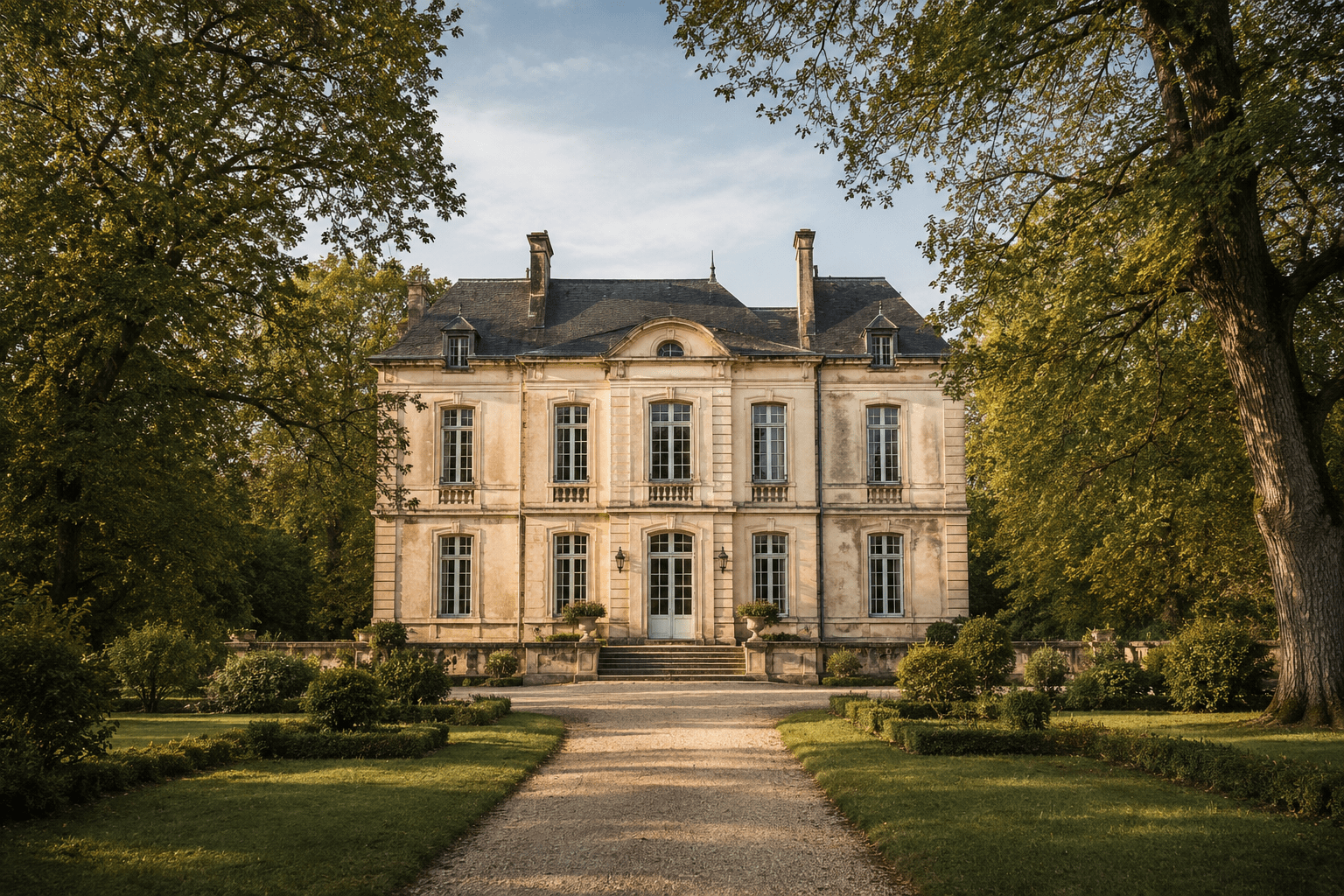
A building can be old, imposing and expensive without being
architecturally significant. In a genuinely exceptional historic villa
or château, the building, the garden, the landscape, the original design
intent, the surviving details and the layers added over time reinforce
one another. Together they create a character that cannot simply be
reproduced somewhere else.
At Villa d’Este in Tivoli there is a subtle visual trick. The palace
does not sit at the exact centre of the overall composition. Earlier
structures made the plan irregular from the outset. Yet the garden
designers used axes, terraces, stairs and water to create a system that
still feels ordered and almost inevitable. The palace loggia establishes
one of the principal directions through the garden, while cross axes
terminate in fountains and viewpoints.
If we looked only at the building’s floor area, number of rooms and
façade, we would miss one of the villa’s most important qualities.
Historic property is often misunderstood in exactly this way.
Size does not make a
property exceptional
Property markets favour what can be measured. Floor area, plot size,
room count, ceiling height, restoration cost. These figures matter, but
they do not tell the whole story.
A château is not architecturally important because it covers five
thousand square metres. A villa is not significant simply because it is
one hundred and fifty years old.
Historic England’s conservation framework therefore does not reduce
significance to a single attribute. Evidential value, historical
associations, aesthetic quality and communal meaning can all contribute
to the significance of a place. French heritage protection similarly
considers historical, artistic, architectural, technical and scientific
interest.
Even the word villa carries more meaning than a modern property
category suggests. In the Italian tradition, the villa developed from a
long history of residences connected to rural and landscape settings.
The Renaissance Medici villas established a new type of residence that
was neither merely an agricultural complex nor governed by the defensive
logic of the medieval fortress. Residence, garden, cultivated life and
landscape became part of one composition.
The first serious question about a historic property is therefore not
how large it is.
It is whether an architectural idea has survived.
The original idea can still
be read
In a well conceived historic house, rooms do not simply happen to
follow one another.
Arrival has direction. The main entrance carries weight. There is a
hierarchy between ceremonial and private rooms. A sequence of doors may
terminate in a window, a sculpture, the garden or a distant feature in
the landscape. A staircase is not merely circulation between floors. It
forms part of the way the building is revealed.
The heritage description of Villa Bünemann in Bremen, for example,
identifies the central hall, the upper level corridor, the balanced
sequence of representative rooms, the proportions and the relationship
of the building to its landscape as significant features. Together they
make the architecture legible.
A poorly altered historic house can retain many original details
while losing this coherence. The stucco remains. The fireplace remains.
Perhaps even the doors are original. Yet a sequence of rooms has been
broken, a hall subdivided, new corridors cut through the plan, or a
principal room fragmented into smaller spaces.
The details may survive while the architecture does not.
A serious buyer therefore looks beyond the question of what is
original. The more important question is how much of the building’s
original logic can still be understood.
The park is not a backdrop
It is easy to treat a château park as an unusually large garden.
Historically, that can be a serious mistake.
The Florence Charter describes a historic garden as an architectural
and horticultural composition of historical or artistic interest. French
heritage policy follows the same principle, while Italian conservation
thinking likewise treats the historic garden as a complex work in which
buildings, vegetation, water and sculptural elements function
together.
This is not an academic distinction.
An avenue can shape the experience of arrival. A clearing can
determine the point from which the house is first seen in full. A lake
can double the façade in reflection. A belt of woodland can close or
open a view. The slope of the land can decide what becomes visible from
a terrace.
At the Károlyi château at Fehérvárcsurgó, János Hein’s early
twentieth century redesign of the park considered the landscape from the
immediate surroundings of the house through to the adjoining woodland.
Clearings, trees selected for contrasting foliage and crown forms, a
lake, stream, bridges and garden structures formed part of one
composition. Later restoration therefore involved more than planting
trees. It returned to the system of water, paths, bridges and other
historic elements.
The relationship between architecture and landscape is also central
to UNESCO’s assessment of the Medici villas. These residences became
influential partly because architecture, garden and setting were
conceived as parts of a single whole.
For a château, losing the park may therefore mean more than losing
acreage.
Part of the original composition disappears with it.
Authenticity is
not the same as untouched condition
There is a seductive idea about historic buildings. Find the original
state, then return everything to exactly that moment.
Conservation practice is far more cautious.
The Venice Charter requires significant contributions from different
periods to be respected. Stylistic unity is not, by itself, the aim of
restoration. Where a building has changed over centuries, a later layer
is not automatically an error to be removed.
The gardens of Château de Bouges offer a particularly useful example.
An eighteenth century composition, a nineteenth century park and later
garden work associated with the Duchêne tradition coexist on the estate.
The French heritage record identifies precisely this harmonious
coexistence of periods and styles as part of the garden’s value.
Authenticity is therefore not sterile time travel.
A thoughtful restoration preserves what is genuinely significant,
interprets later changes and decides only after proper research what
should remain, what may be restored and where contemporary intervention
is appropriate.
New work does not need to disguise itself as historic fabric. The
Venice Charter expects additions to respect the whole while remaining
identifiable, so that the documentary value of the building is not
falsified. Current British conservation practice also favours reversible
solutions where possible, provided that the intervention itself is
justified.
Sometimes the most truthful quality of a one hundred and fifty year
old house is that one hundred and fifty years can still be seen in
it.
History
adds value, but it does not replace architecture
The history of a property can be genuinely significant.
Who designed it. Who commissioned it. What role it played in the life
of a family or a place. Whether something occurred there that mattered
beyond the building itself. Whether it is connected to an important
architect, artist, political figure or cultural period.
One form of historical value lies precisely in these associations.
Historic England recognises the capacity of a place to connect people
and events across time.
But a famous name is not magic dust.
Weak architecture does not become excellent because a well known
person once lived there. Equally, an architecturally remarkable villa
does not become less significant because its first owner is now largely
forgotten.
In the strongest historic properties, architecture and history
reinforce one another. The building helps us understand the way of life
and the period that produced it. The history helps explain why the
building took the form it did.
Exceptional
properties carry exceptional obligations
The romantic photograph is usually taken from the park.
The less romantic photograph is taken beneath the roof, in the cellar
or in the plant room.
Owning a historic villa or château is not purely an aesthetic
decision. Certain buildings require specialist materials, scarce crafts
and a high level of expertise to repair. Structure, damp, roofing,
windows, heating, electrical systems and the maintenance of the grounds
can introduce substantial cost and uncertainty. RICS guidance on the
valuation of heritage assets also warns that inexperienced buyers may
underestimate repair costs while further defects may emerge during
investigation.
Modern comfort is not merely a technological question either.
Introducing services, insulation, a lift or new bathrooms into historic
fabric creates a different problem from installing them in a new
building.
The objective is not to turn the property into a museum. European
conservation thinking accepts new uses when they respect the values
already present. The Leeuwarden Declaration treats adaptive reuse as a
means of giving buildings viable new functions without sacrificing their
cultural, historical and spatial significance.
Modernisation is not the enemy of a historic building.
Poorly conceived modernisation is.
For the same reason, it is dangerous to assume that heritage status
automatically creates a market premium. Research in Berlin, Auckland and
other markets has produced differing results on the effect of
designation on value. Historic character may attract buyers, while
restrictions, costs and risk can reduce the willingness of others to
purchase.
Cultural significance and market liquidity are not the same
thing.
What does a serious buyer
look for?
Viewing a property of this kind requires several different
readings.
The first is the building itself. Can the original spatial structure
still be understood? Have the rooms, relationships and proportions that
gave the house its character survived? What is original, what is a
valuable later layer, and what is simply an unfortunate alteration?
The second is the place. How do we arrive? How does the principal
façade relate to the park? Do historic views, axes, avenues, water
features and ancillary buildings remain? Is there still an estate, or
has the château been left isolated on a severed plot?
The third is the future. What does the next owner intend to do with
the property, and can that use be accommodated without removing the very
qualities that make the building exceptional?
Hungarian heritage practice shows how broad this assessment can
become. In a 2024 protection document for Kégl Castle, the listed values
extend beyond massing, roof, façade and ornament. They include the
internal spatial organisation, original doors and windows, mature trees
in the park, the historic promenade, ponds, island, boundary structures
and remains of the water system.
That perhaps brings us closer to what deserves attention.
Not how many spectacular details survive in an old house.
Whether the whole still makes sense.
At Villa d’Este the axes of the garden still tell us how to read the
place. Palace, terrain, water and garden explain one another. In an
exceptional historic villa or château, we are looking for something
similar. Not necessarily monumentality. Rather, a coherence that cannot
simply be recreated in a new building, however much money is spent.
The task of the next owner is not to return the property to an
imagined past. It is to understand what has been acquired, and what
deserves to be carried forward.
Sources and further reading
Historic England
Conservation Principles
https://historicengland.org.uk/advice/constructive-conservation/conservation-principles
Villa d’Este, Ministero della Cultura
https://lazio.cultura.gov.it/?page_id=5705
Bremen Monument Preservation, Villa Bünemann
https://www.denkmalpflege.bremen.de/denkmaeler/villa-buenemann-51599
Ministère de la Culture, Parcs et jardins
https://www.culture.gouv.fr/thematiques/monuments-sites/monuments-historiques-sites-patrimoniaux/les-monuments-historiques/les-parcs-et-jardins
UNESCO, Medici Villas and Gardens in Tuscany
https://whc.unesco.org/en/list/175/
ICOMOS, Venice Charter
https://www.icomos.org/images/DOCUMENTS/Charters/venice_f.pdf
POP, Château de Bouges
https://pop.culture.gouv.fr/notice/merimee/PA00097284
Károlyi Château Park, Fehérvárcsurgó
https://koee2018.kormany.hu/14-europai-disznoveny-es-kertmuveszeti-napok-2018-fehervarcsurgo
RICS, Valuing heritage assets
https://ww3.rics.org/uk/en/journals/property-journal/valuing-heritage-assets.html
Leeuwarden Declaration
https://upa-bua-arch.be/en/profession/le-cadre-professionnel-des-architectes/ace-cae-declaration-from-leeuwarden-2018
Kégl Castle protection document
https://digitalismegujulas.kormany.hu/akadalymentes/download/6/f6/43000/MK_24_081.pdf