
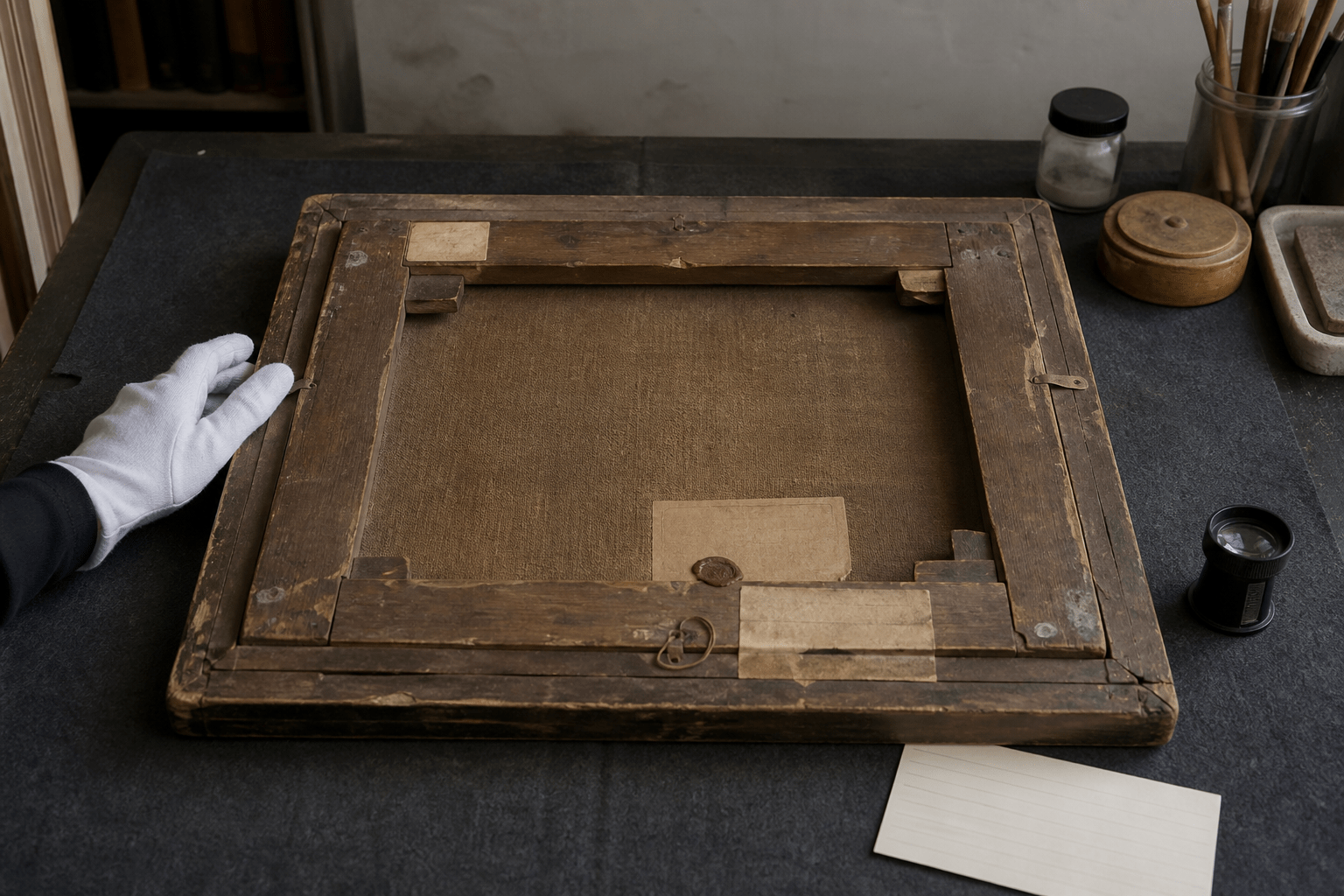
A label on the back of a painting can outlive the person who placed it there.
At the Getty, researchers documenting the versos of paintings noticed the same Ernest Brown & Phillips dealer labels on works that otherwise appeared unrelated. One was Sebastiano Ricci’s Diana and Her Dog. Two others were William Hogarth’s Before and After. The stock numbers led back to the London dealer’s records, and those records showed that all three paintings had been sold in January 1936 to the Swedish publisher and collector Thorsten Laurin.
The connection had been hiding in plain sight, but not on the painted surface.
The works later reached J. Paul Getty through separate Sotheby’s sales, years apart. Before the labels were investigated, Laurin was known in the museum’s records only in much less specific terms. A few marks on the backs of three paintings, checked against an archive, recovered part of a shared history.
This is provenance research at its most tangible. It begins with evidence that may look insignificant and asks where it leads.
An artwork has a biography
In its narrow professional sense, provenance is the history of ownership and transfer of an object. Who owned it, when, where, and by what route did it pass from one collection to another?
That sounds simple. In practice it rarely is.
A painting may move through a dealer, an auction house, an inheritance, a private collection and a museum before arriving at its present owner. Some transfers leave invoices and catalogues. Others survive only through an inventory number, a handwritten note, a customs stamp or a line in a dealer’s stock book. Older works may contain decades, sometimes centuries, for which the evidence is incomplete.
The Metropolitan Museum of Art has described provenance research in terms of an object’s biography. The analogy is useful because ownership history is not merely a decorative list of prestigious names. It is an attempt to reconstruct how an object travelled through time and through human hands.
Provenance should also be kept distinct from the other records surrounding an artwork. Exhibition history, literature, catalogue raisonné entries, certificates and condition documentation may all help a researcher understand an object, and they may support or challenge parts of its history. They are not automatically provenance themselves.
That distinction matters. Good documentation becomes stronger when each piece of evidence is allowed to say exactly what it can say.
The story may begin on the back
Auction catalogues and invoices are obvious places to look, but the artwork itself can be a document.
The Getty’s work on painting versos shows how much information can accumulate there. Dealer labels, collection marks, wax seals, exhibition stickers, transport labels, inventory numbers and handwritten inscriptions can connect an object to places and people that have disappeared from its public history.
A number on a stretcher may mean very little on its own. Put it beside the stock book of the dealer who wrote it, and suddenly it can provide a date, a buyer and a transaction.
This is why provenance research is not romantic detective work in which every mysterious stamp unlocks a secret. A label can be moved. Handwriting can be misread. Documents can contain errors. Records can be missing. Evidence becomes persuasive when object, archive, chronology and comparison begin to agree.
The same principle applies to paperwork. An invoice may establish that a transaction was recorded between particular parties at a particular time. A catalogue may place a work in an auction or exhibition. A museum inventory may establish institutional custody. A letter may reveal what an owner believed the object to be.
None of those documents should be asked to prove more than they actually establish.
What provenance can support, and what it cannot
A coherent ownership history can strengthen confidence around an artwork. It may support an attribution, connect a work to an artist, dealer or known collection, clarify how and when ownership changed, and reveal whether the object’s documented history is consistent with what is being claimed about it.
But provenance is not authentication.
A convincing ownership history does not, by itself, prove that a painting is by the artist named on the label. Nor does it automatically establish legal title, originality or condition. A false attribution can acquire a long history. Documents themselves can be mistaken, incomplete or fabricated.
This is why serious examination separates related questions instead of blending them together.
Who owned the object?
What evidence supports the attribution?
What does technical or condition examination show?
Is there a clear legal basis for the transfer?
Do the documents themselves withstand scrutiny?
The answers may reinforce one another, but they remain different questions.
Within fine art, this is an important shift in perspective. The presence of provenance is not a green light. The absence of a perfect chain is not automatically a red light. What matters is the quality of the evidence, the significance of any uncertainty and the type of object under consideration.
A gap is not always suspicious, but it is always a question
Perfect ownership histories are uncommon, particularly for older objects.
Wars destroy archives. Dealers close. Estates are dispersed. Families move. Records are lost. A work may spend decades in a private collection whose owner never sought publicity. In some cases an institution or intermediary may know the identity of a private owner while respecting that person’s request for anonymity.
A gap therefore does not prove that something is wrong.
It does, however, tell us where the research is unfinished.
Some periods demand greater attention than others. For works circulating in Europe between 1933 and 1945, missing ownership history may raise questions connected with Nazi persecution, forced sales, looting and later restitution claims. Museums, governments and market participants have developed dedicated research practices around this period, and the Washington Principles remain an important international reference point for Nazi-confiscated art.
The purpose of raising such questions is not to treat every undocumented year as evidence of wrongdoing. It is to recognise that apparently quiet gaps can carry very different levels of legal, ethical and historical risk.
The same due-diligence logic applies more broadly. ICOM standards place provenance research and ownership documentation within responsible museum acquisition practice. INTERPOL’s database of stolen works of art is another reminder that an object’s history can intersect with loss, theft and illicit movement.
For a significant transaction, unresolved issues may require the involvement of specialists such as provenance researchers, art historians, lawyers, conservators or other relevant experts. Provenance research is part of that process, not a substitute for all of it.
When history becomes part of value
Collectors often associate provenance with famous previous owners. There are cases where that association genuinely matters.
A work that passed directly from an artist to another important artist, collector or patron can carry a historical connection that changes how the object is understood. Christie’s has highlighted examples in which relationships between artists and collectors form a meaningful part of an artwork’s story. In such cases, the previous ownership is not simply a decorative pedigree. It can provide context for how the work circulated, who encountered it and why it mattered at a particular moment.
Yet market value is more complicated than a celebrated name in a catalogue entry.
One function of good documentation is to reduce uncertainty. A well-recorded object can be easier to research, assess and transact than one surrounded by unanswered questions. Another function is historical. A documented connection to an important collection, patron, artist or institution may add significance of its own.
Research published in Management Science has found measurable relationships between documented trust signals around artworks and auction outcomes across a very large sample of transactions. The useful conclusion is not that provenance adds a fixed percentage to value. The study’s categories extend beyond ownership history alone, and no universal provenance premium exists.
The more defensible point is simpler. Information, documentation and confidence can have economic consequences.
The art market does not value a story merely because it is attractive. It values evidence when that evidence changes what buyers can reasonably believe about the object.
Provenance begins today
It is easy to speak about provenance as though it belongs to old masters, wartime archives and historic collections.
Contemporary art makes the opposite point.
The future provenance of a work being made today begins with ordinary acts of documentation. The studio inventory. The first invoice. The identity of the first buyer. The first gallery. The record of a transfer. A dated photograph. Exhibition information kept in the correct category. Correspondence that explains a transaction or custody.
Not all of these things are provenance by themselves. Together, however, they create the documentary environment from which an ownership and movement history can later be reconstructed.
What is not recorded today may have to be rediscovered twenty or fifty years from now.
That creates a responsibility on both sides of a transaction. Artists and their representatives should preserve meaningful records. Collectors should understand what documentation accompanies a work and keep it with the object rather than allowing invoices, certificates and correspondence to disappear into unrelated files.
The same is true when an owner sells. The next custodian of the artwork inherits not only the physical object but also whatever part of its history has survived.
Before a collector decides
A few questions can reveal more than a long list of names.
What documents support the known ownership history?
Are there periods that cannot currently be documented?
Is the provenance being used to support an attribution, and if so, what independent evidence exists for that attribution?
Are provenance, exhibition history, literature and certification being presented as separate categories?
Are there periods, jurisdictions or circumstances that call for specialist legal or historical review?
Which original documents, copies and records will pass to the buyer with the artwork?
There will not always be a complete answer to every question. That is not unusual. The objective is not to manufacture a flawless history where none exists. It is to know what is documented, what is inferred, what remains unknown and whether that uncertainty matters to the decision.
A painting can survive for centuries while the paper around it disappears surprisingly quickly. The invoice kept today, the studio record entered correctly, the dealer label photographed before reframing, or the collector’s documentation preserved with the object may become the evidence that allows someone much later to understand where the work has been.
Sources and Further Reading
- J. Paul Getty Museum — Provenance research; painting versos
- The Metropolitan Museum of Art — Provenance research; Nazi-era provenance research
- National Gallery of Art — Provenance; catalogue conventions
- Christie’s — What does provenance mean?
- ICOM — Code of Ethics
- INTERPOL — Stolen Works of Art Database
- U.S. Department of State — Washington Conference Principles
- Management Science — In Art We Trust