
What does continuity mean for a historic estate?
The history of a country house does not begin at its walls, and it does not end there either.
For centuries, the great historic estates of Europe were complex systems. The principal house was simply their most visible expression. Around it stood the park, the woods, the farms, the stables, the chapel, service buildings, libraries, archives, furniture and works of art. Around all of those stood people. Owners, tenants, gardeners, foresters, stewards, craftsmen and families whose connection with a place might extend across generations.
An estate was therefore more than real estate.
That becomes obvious when we look at historic ensembles that have survived with much of their original structure intact. The Residences of the Royal House of Savoy around Turin, for example, were not a loose collection of palaces. Urban residences, country villas, hunting lodges, roads and landscape formed a deliberately organised political and cultural system. UNESCO treats that relationship between buildings and territory as part of the significance of the ensemble itself.
The same principle applies on a smaller scale to a family estate.
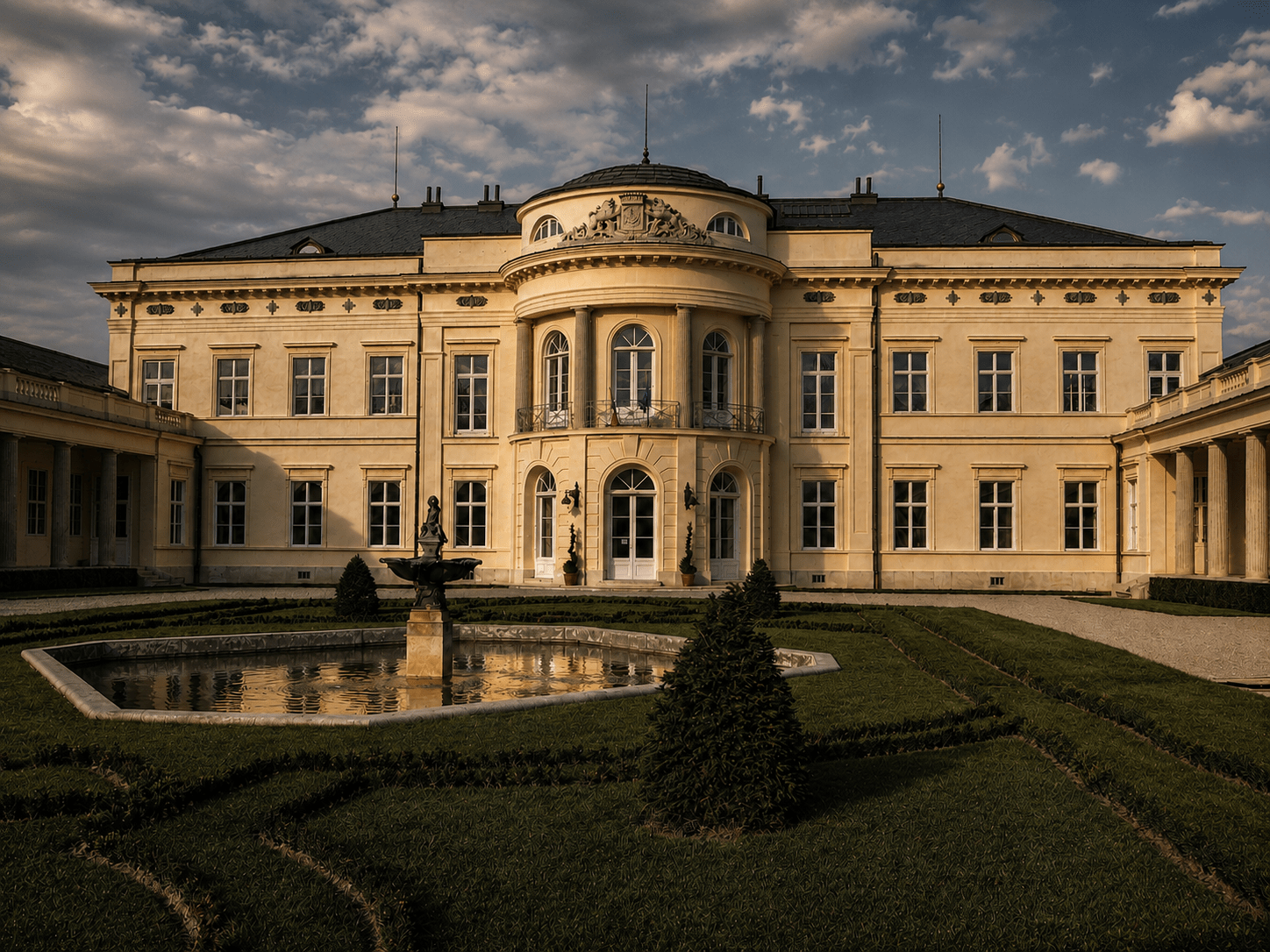
The Károlyi Castle at Fehérvárcsurgó is a particularly useful Hungarian example because it shows how fragile that unity can be. The family left the estate in the autumn of 1944. During the war the house served as a military hospital, and much of its furnishing disappeared or was destroyed. After nationalisation it became, in succession, a holiday facility, a refugee home and a children’s home. Parts of the park were separated from the historic estate, other areas were built over, and the old economic surroundings gradually disintegrated. The castle itself survived. The system to which it had belonged had already been broken apart.
That distinction matters.
A historic building can survive physically while losing its relationship with the things that once gave it meaning.
The house can be separated from its park. The park from the farm. The farm from the surrounding land. Furniture, paintings and books can leave the rooms. Family papers can enter public archives, works of art can pass into museums or private collections, and within a few generations the descendants of former estate staff may lose much of the knowledge that tied their families to the place.
In the end, a beautiful building may remain.
Sometimes even that is fortunate.
But the historical world that produced it may no longer exist.
Tyntesfield in England offers almost the opposite case. Richard Gibbs died without children in 2001 and left the estate to nineteen beneficiaries. They could not keep the inheritance together, and the house, its contents and the estate were offered for sale as a whole. The National Trust acquired it the following year with the help of public donations and grant funding. The importance of Tyntesfield lay precisely in the fact that an unusually complete Victorian estate had survived, not merely a significant house.
The contrast is revealing.
At Tyntesfield, continuity of family ownership ended, yet much of the historical ensemble remained intact. At Fehérvárcsurgó, the loss of the family was accompanied by the fragmentation of ownership, economy and contents. Restoration in the two places therefore confronted fundamentally different problems.
Continuity cannot simply be measured by asking how many years the same surname has appeared on a title deed.
Family presence can matter enormously. But it is not enough on its own.
An estate may remain in the same family for centuries while its land is sold away, its collections dispersed, its park altered and its economic role exhausted. Elsewhere the original family may no longer own the property, yet the house, collection, archive, landscape and a surprising amount of historic context may survive.
Continuity is better understood as a network of relationships.
The relationship between the building and its landscape. Between objects and rooms. Between family papers and the people who produced them. Between the estate and the surrounding settlement. Between contemporary use and the history of the place.
When too many of those relationships are severed, what is happening is no longer merely a change of owner.
The identity of the place begins to disappear.
At Bonțida in Transylvania, that process can almost be read as a textbook case. Bánffy Castle deteriorated severely after the war and during the communist period. Parts of the complex were later used for mushroom cultivation, poultry keeping, rabbit breeding and other purposes with no connection to the historic ensemble. The property was eventually returned to the family, and Katalin Bánffy entered into a long-term arrangement with the Transylvania Trust. Restoration is no longer simply a matter of putting new plaster on old walls. The castle functions as a cultural and educational centre, conservation professionals are trained there, and interpretation reconnects the site with Miklós Bánffy and the family’s centuries-long presence.
That brings us closer to what genuine rehabilitation can mean.
It does not necessarily mean recreating the last peaceful year before everything changed.
History cannot be reversed. The decades in which a castle served as a children’s home do not disappear because they sit awkwardly with an aristocratic narrative. A wartime hospital, nationalisation and later communal uses may all become part of the biography of a building. The real question is whether a new owner or custodian can interpret those layers without losing sight of what came before them.
Continuity, then, is not the same as immobility.
It means that enough relationships survive through change for the place to remain recognisably itself.
And this is where the problem really begins. Across Europe, many historic estates did not simply change hands in the twentieth century. War, revolution, land reform, nationalisation, persecution, economic collapse and inheritance disputes broke the systems that had sustained them.
The next question is therefore not simply who became the new owner.
It is how a continuity that had lasted for centuries was broken, and what remained afterwards.
How does continuity break?
Rarely in a single day.
It is tempting to imagine the end of a historic estate as a dramatic event. The last heir dies. The gates close. A new regime takes the house. An auction catalogue appears. In reality, the break often starts years before anyone admits that an era has ended.
First the distant fields are sold. Then a few pictures. One wing is closed because it can no longer be heated. The gardener is not replaced. A strip is cut from the edge of the park. One heir moves abroad. Another has no interest in the property. Shares in the family company pass into more and more hands. The house still stands where it always stood, but the system around it begins to loosen.
At other times a single political decision really does cut the thread.
From the outside, the two situations may eventually look similar. Both can end with an oversized house, too little money, an uncertain function and an owner unable to continue the life of previous generations. Yet the route matters. If we want to give a historic estate a new future, we first have to understand what was actually broken.
Sometimes the family simply runs out.
Not necessarily in the literal sense. It is enough that there is no heir, or no group of heirs, willing to take responsibility for the whole.
That is what makes Tyntesfield so instructive. Richard Gibbs died childless. Nineteen beneficiaries inherited the estate and, collectively, could no longer or would no longer maintain it in its existing form. House, contents and land went to the market together. There is no villain in this story. No confiscation. No wartime destruction. Ownership simply evolved into a structure in which the old unity was no longer natural.
This is one of inheritance’s less dramatic risks.
A great estate may have remained coherent for generations because a single family decision-making centre held together house, farms, woods, collection and staff. If the next generation requires five, ten or twenty people living in several countries to agree on every roof repair, land sale and capital investment, ownership itself can become the enemy of continuity.
Not because the heirs are worse people.
Because they have different lives.
To one, the house may be home. To another, a memorial. To a third, a loss-making asset. To a fourth, capital that could educate children or finance another business. Every position may be rational. The estate cannot operate according to all of them at once.
Family continuity is therefore not only a matter of bloodline.
It is a matter of governance.
The second fracture appears in the finances.
There is a tendency to discuss great houses romantically. Gutters, drainage, heating, electrical systems, park management, insurance, staff, access roads and decades of deferred maintenance are less romantic.
The twentieth-century crisis of the British country house is useful precisely because no single cause explains it. Two world wars, military occupation of houses, changing agricultural income, the disappearance of large domestic staffs, taxation, inheritance and accumulated repair liabilities all acted together. At the height of the crisis, forty-eight country houses were recorded as demolished in Britain in 1955 alone.
Almost one a week.
Parliamentary debate from the period makes clear that the crisis concerned more than buildings. MPs spoke of parks being felled, gardens neglected and owners selling pictures, furniture and other valuable objects simply to keep the house going for another few years.
In other words, the same process was taking place that we have already identified.
The unity of the estate was being consumed.
Selling a painting can be a perfectly rational decision. So can selling a field. But if every generation finances the next major repair by disposing of another piece of the historic system, the estate slowly eats itself. The house may survive, but less and less remains around it of what once sustained and explained it.
Britain is especially interesting because the law eventually began to recognise this problem. Current heritage taxation can, in certain circumstances, give conditional exemption to outstanding historic buildings, land and associated objects. In return, owners accept obligations relating to preservation and access. Crucially, the official framework treats the house, associated land and historically connected objects as a heritage entity and explicitly seeks to discourage fragmentation.
That is an important intellectual shift.
Not because every country should copy British tax law.
Because it recognises the same principle. A historic house cannot always be protected by protecting only the walls.
Calke Abbey demonstrates what can happen when an institutional solution exists. The Harpur Crewe family had been associated with the estate for more than three centuries, but by the time of the last family owners, taxation and the cost of the property had become impossible to manage in the old way. The estate was ultimately offered in satisfaction of tax liabilities and passed into the care of the National Trust. Not only the house, but the contents, park and substantial agricultural land remained connected.
Family ownership ended.
Estate continuity, however, survived to a remarkable degree.
That distinction may be one of the most important in the entire subject.
An owner can change while the identity of a place remains. And the owner can remain while the identity of the place disappears around them.
Central Europe experienced a different kind of break in the second half of the twentieth century.
In Hungary, the land reform launched in the spring of 1945 aimed to dismantle the large-estate system and redistribute land to people with little or none. It would be intellectually lazy to treat this retrospectively as if it had been merely a conservation issue. It was not. It was a political response to profound social tensions in a country where the structure of landownership had been contested long before the war ended.
For historic estates, however, the consequences were often dramatic.
The economic relationship between country house and landed estate was severed.
A great residence had rarely financed itself. Woods, arable land, leases, livestock, mills, farm buildings and other enterprises provided the income from which the house, park and household could be maintained. Once the economic estate disappeared and only the residence remained, a new owner or public institution inherited a very expensive building without the system that had paid for it.
Nationalisation then added another layer. Aristocratic families were not treated simply as former owners. Erasing their social role was itself part of the political project. In many places the connection between family and estate did not fade gradually. It was deliberately cut.
The result was not immediate ruin everywhere.
That qualification matters.
Many castles and mansions received new functions. They became schools, hospitals, sanatoria, children’s homes, holiday centres, offices, warehouses or agricultural institutions. In some cases occupation saved buildings from abandonment. Elsewhere insensitive alterations, poor maintenance and indifference to historic context accelerated deterioration.
The history of nationalisation cannot therefore be reduced to one sentence.
Loss of legal ownership was only part of the change.
Loss of the operating logic was another.
Füzérradvány is particularly revealing because the family had already recognised before the war that the old estate model might not survive unchanged. In the second half of the 1930s, István Károlyi and his wife converted the family residence into a castle hotel. Tennis courts, a golf course, bathing and other leisure facilities appeared in the park. The idea was not simply to let strangers into the house. It was to create an economic function that could provide work locally and turn the castle from a liability into an operating asset for the next generation.
The war interrupted the experiment.
Yet Károlyi returned. Archival records show that by the spring of 1946 he had regained possession of the castle with a greatly reduced section of the park. Attempts were made to recover dispersed contents and the hotel reopened.
For a brief moment, another future was visible.
Not a restoration of the old aristocratic world.
Not a museum either.
A historic house remaining in family ownership while adapting to a new economic use.
The experiment did not end because the business model failed. The castle hotel closed in 1948, and nationalisation in 1949 permanently deprived the Károlyi family of the property.
The distinction is fundamental.
If a historic hotel fails because guests do not come, we can draw business conclusions. If it disappears because the ownership system itself is abolished, we need to ask a different question.
What might have happened if they had been allowed to continue?
There is no reliable answer. But the question matters because it reminds us that modernisation of historic estates in Central Europe did not always fail because old owners were incapable of change. Some were already searching for new forms of operation before the war. Political rupture interrupted those experiments too.
Czechoslovakia experienced a similarly profound break in ownership, followed by a different process after the fall of communism.
The Lobkowicz family’s properties and collections were confiscated first by the Nazis and then, after 1948, by the communist state. The family went into exile. William Lobkowicz returned permanently to Czechoslovakia in 1991 and began restitution proceedings. According to the family’s own account, the process continued for more than twenty-five years. It was not simply a matter of recovering buildings. Collections, libraries, archives and objects that had been separated from one another had to be identified and reconnected.
Restitution was not the handing over of a key.
It was reconstruction in the broadest sense.
The Czech legal framework for land restitution itself proceeded from the principle that some property injustices committed between 1948 and 1989 should be mitigated. Yet the property returned was often no longer the functioning economic unit that had been taken decades earlier.
This is one of the hardest legacies of rupture.
A castle can be returned.
Lost time cannot.
Nor can a vanished household, scattered furniture, alienated land, severed economic relationships or the effortless local knowledge that comes from generations growing up on the same estate.
Bonțida in Romania offers an even harsher version. The Bánffy family had been connected with the estate for centuries before nationalisation. At the end of the Second World War the castle was badly damaged and much of its furnishing destroyed or dispersed. Under state ownership, the site housed an agricultural machinery station and later uses included poultry, mushrooms and rabbits.
Eventually the property returned to the family.
That did not make the castle whole.
The long-term agreement between Katalin Bánffy and the Transylvania Trust acknowledges that reality. The family reconnects with the estate while a specialist organisation coordinates restoration and contemporary operation. Cultural and educational functions have emerged. The castle does not pretend that the twentieth century never happened.
This may be one of restitution’s most important lessons.
Restoring legal title and restoring historical continuity are not the same operation.
The first requires law and evidence.
The second requires time, money, knowledge, institutions, family memory and an economic model.
And sometimes humility.
Not every thread can be tied again. Some family collections survive only in fragments. Parts of parks are now covered by houses. Farm buildings have vanished. Archives are divided between countries. The people who remembered how rooms were used or how the estate worked are no longer alive.
This is why the phrase „restored to its original condition” is so often misleading.
Original when?
1890? 1938? The post-war period? The last family interior? The first architectural phase?
A house that has existed for centuries has no single original moment.
It has layers.
And every break in continuity wounds a different one.
The disappearance or dispersal of a family threatens personal memory and a unified centre of decision-making. Fragmented inheritance threatens coherent ownership. Economic crisis first damages maintenance, then land and collections. War can destroy physically. Nationalisation may sever owner, economic base and contents at once. Restitution may reverse legal dispossession without automatically restoring anything else.
That is why the correct first question differs from estate to estate.
It is not yet what the new use should be.
First we need to know what survived, and what did not.
Because the quality of every later decision depends on whether the owner, investor, state or institution can distinguish between an empty historic building and a damaged but still coherent historic estate.
The next thing to understand is what disappears first when that coherence begins to fail.
What disappears first?
Not necessarily the park.
An old tree can stand for a very long time, sometimes long after the house has been abandoned and the family has been gone for decades. Walls, too, can be surprisingly tenacious. A library, an archive or a furnished room needs far less time to disappear.
A few hours may be enough.
An unlocked gate. A lorry. A fire. An auction. A handful of people who see books as fuel, furniture as timber and silver as money.
When we talk about the disintegration of a historic estate, we therefore tend to watch the building for too long. We look at the roof, the plaster, the park. They are visible. They photograph well. They can be surveyed. Some of the most sensitive losses may already have taken place long before the masonry begins to fail.
Polgárdi is a painful Hungarian example.
The Batthyány castle no longer exists. It was badly damaged in the Second World War, the ruins were subsequently scavenged and the building was eventually demolished. The fate of the family library is particularly important because it shows how quickly a layer can disappear that no architectural reconstruction could ever restore.
According to the library of the Szent István Király Museum, Russian soldiers burned part of the Polgárdi collection as fuel. Some volumes nevertheless survived. A recollection by former museum director Jenő Fitz records that Gyula Batthyány personally brought surviving books into the museum.
Those remaining volumes matter for far more than their age.
They retain ownership inscriptions, ex libris plates, coats of arms, monograms, library labels and consistent bindings that identify them as part of a once coherent collection. Traces of the original classification survive as well. Museum research indicates that the library was organised into seventeen subject groups. The highest surviving known shelf number is 4581, suggesting that the collection contained at least that many volumes.
We do not know where every book went.
Nor should we claim that the entire library was burned. The surviving evidence is more precise. Part was lost during the war and fighting, some was burned by Russian soldiers, and a fragment survived.
That precision makes the story more powerful, not less.
Great collections do not always vanish in a single spectacular act. They break apart. Some volumes burn. Others are carried away. A few are rescued. Decades later a librarian tries to identify what once belonged together from a coat of arms, a handwriting sample, a binding or a tiny paper label.
Near the former castle, the remains of an enormous giant sequoia still recall the park. Local tradition associates its planting with István Batthyány in the first half of the nineteenth century. The town’s historical account says that Soviet soldiers used the hollow trunk for fires and as a target.
Yet the tree remains.
Most of the library does not.
That is why it is too simplistic to say that the park is always the first thing to disappear. Vegetation can become overgrown. A formal avenue can thin out. Parcels can be severed. But a tree may preserve the memory of a place longer than the paper on which its history was written.
Books and archives are particularly vulnerable.
At Acsa, the story of the Prónay family library is even more brutal. An official post-war survey recorded that the castles had been looted. The local chief clerk reported that Russian troops made villagers carry the library and archive out into the park. The work took four days. The material was then burned.
Four days.
Generations may be required to create a collection. Less than a week can be enough to destroy it.
The loss of a library is already a cultural loss. The destruction of an archive cuts more deeply still.
Another copy of an old book may exist elsewhere. A family letter may have existed only once. An estate diary, a building invoice, a gardener’s note, a pencilled remark on the edge of a plan, or a name written on the back of a photograph can preserve information that exists nowhere else.
When such material disappears, we do not merely lose an object.
We lose certainty.
A room can later be restored. A period wallpaper can be reproduced, parquet remade and a fireplace reconstructed. But without inventories, photographs, correspondence and drawings, a point eventually comes at which restoration gives way to probability.
Those are not the same thing.
Furniture and decorative arts are equally vulnerable because the importance of a historic interior rarely lies in the fact that it contains a number of old objects. Its meaning comes from relationships between them. A desk stood in the room where particular letters were written. A portrait watched over several generations of the same family. A bookcase was designed for a specific wall. Carpet, curtains, lighting, furniture and pictures belonged to one spatial composition.
Break that composition apart and the individual objects may survive perfectly well.
The interior nevertheless dies.
Croome Court in England shows how far dispersal can go. During the twentieth century much of its original furnishing was sold and scattered. Even architectural elements left the house. The monumental bookcases designed by Robert Adam for the library were acquired by the Victoria and Albert Museum in the 1970s. Only decades later could they begin to return to the room for which they had been created.
That is a hopeful story.
It is hopeful because the objects were identified and their provenance remained known.
Dispersal is not always final if the relationship is documented.
That is one of the most important meanings of provenance beyond the art market. A chair can outlive a castle. A painting can travel through auction rooms and across borders. A book can reappear in an antiquarian shop. If the knowledge of where it came from and what role it played survives, some part of the historical relationship survives too.
When that knowledge is lost, the object becomes an orphan.
The surviving Polgárdi books remain valuable because marks on the objects themselves can still reconnect them to the collection from which they were torn.
Many things carry no such mark.
A simple chair, table, porcelain service, curtain or everyday object can lose its history very easily. By the time somebody tries to reconstruct the interior decades later, the object may still exist. Nobody simply knows that it ever stood there.
Sometimes the lost relationship matters more than the lost thing.
Photographs reveal this with particular cruelty.
A family album may preserve a room for which no architectural survey was ever made. It can show where a cabinet stood, which picture hung beside a door, how the terrace was used, what grew outside a window. In one corner there may be a person whose name was never written on the back.
As long as someone recognises the face, the photograph contains knowledge.
Afterwards, there is only a face.
Personal memory disappears in exactly this way.
Burned books and archives leave visible absences. Human knowledge often vanishes quietly. The last gardener who remembered when an avenue was planted dies. The last member of staff who knew where a portrait hung is gone. The next family generation grows up abroad. Fewer residents of the village remember how the estate looked before its largest alterations.
Fifty years later we try to rebuild the same information from archives.
If the archive is gone too, we are left guessing.
This is why former owner families can remain crucial even when they no longer own the estate.
Not because family memory is infallible.
It is not.
Memory is selective. It can romanticise. It can forget uncomfortable things. The recollection of a descendant does not replace documentary evidence, nor does it override the experience of a local community.
But it can provide a key that opens doors otherwise closed.
A descendant may identify someone in a photograph, recognise a painting, know which branch of the family took papers abroad, or still possess correspondence, plans, albums and objects that can later be reconnected to the estate.
Families of former staff can be just as important.
The memory of a historic estate never belonged solely to its owners. The cook, gardener, forester, steward, maid and local craftsman saw different parts of the same world. A family photograph may show a formal dinner. A local recollection may explain how the food reached the table.
Both are history.
Only then do we come back to the park.
Landscape loss is often slower, which makes it easier not to notice.
Pruning stops. Paths close. A clearing disappears. Trees are removed. A pond silts up. New buildings enter historic views. Plots are cut from the edge of the estate. A road divides an old composition.
After decades, the outline on a map may still be recognisable while the spatial experience has been completely altered.
Sometimes vegetation preserves what people have forgotten. An old avenue may reveal a vanished route. A solitary mature tree may indicate a former boundary. Foundations can survive beneath shrubs. Landscape is not merely a backdrop.
It is a source.
But we can only read it if there is something with which to compare it. Old maps. Photographs. Garden plans. Letters. Inventories. Oral testimony.
The circle closes.
Even the landscape may depend on the piece of paper that someone burned half a century earlier.
For that reason, the first conservation task on a threatened estate is not always restoration.
It may be to stop memory itself from fragmenting.
Record what remains in the house. Photograph objects. Digitise documents. Contact the family. Find descendants of former employees. Gather local photographs. Identify dispersed works of art. Survey the park and historic boundaries. Record even things that initially appear insignificant.
A broken chair can be replaced.
The information about whose chair it was and beside which window it stood may not be.
Saving historic estates is therefore partly a race against time for reasons that have nothing to do with a leaking roof.
Every year there are fewer people who remember something. Every estate sale can send another object beyond the reach of provenance. Every unsorted box of papers risks being mistaken for waste.
Walls are visible.
Knowledge is not.
Perhaps that is why we so often discover its loss only after it has gone.
What can be brought back, and what cannot?
Restoration contains a dangerous moment.
Once money is available, plans are approved and a building begins to resemble its old photographs again, it becomes easy to believe that enough determination can bring everything back.
It cannot.
A collapsed vault can be rebuilt. A missing window profile can be remade. Where drawings, photographs, fragments and other reliable evidence survive, former interiors can sometimes be reconstructed with astonishing precision. Conservators now work with analytical, archaeological and digital tools that would have been unimaginable a few decades ago.
But technical ability is not the real limit.
Evidence is.
One of the central principles of the Venice Charter is that restoration must stop where certainty ends and conjecture begins. At first that can feel frustrating. Owners understandably want to see a lost salon, a vanished library or a decorative scheme restored. Yet when we no longer know what was there, filling the gap ceases to be recovery of the past.
We begin to manufacture a past.
That does not mean every absence must remain empty.
Conservation thinking itself has evolved beyond a narrow obsession with untouched original material. The Nara Document on Authenticity recognises that authenticity can also reside in form, use, function, skills, setting and less tangible qualities of a place.
That matters enormously for historic estates.
If authenticity meant only fabric that nobody had ever altered, most European country houses would fail the test. They were changed continually. Wings were added. Windows altered. Baroque interiors became classical ones. Gardens were redesigned. Chapels moved. Bathrooms and modern services appeared long before the word conservation entered common use.
Change does not automatically make a place false.
Sometimes change is the history.
Bonțida illustrates this particularly well. Restoration of Bánffy Castle does not attempt to erase every twentieth-century trace. A Romanian inscription from the period when part of the complex was used by the agricultural machinery station survives above an entrance. The Transylvania Trust’s approach emphasises minimum intervention, traditional techniques and compatible materials.
This is not aesthetic laziness.
It is an argument.
It says that the history of the castle did not end in 1944. Fire, nationalisation, alien uses and unsuccessful earlier interventions are part of the building that exists today.
Such restoration can look less polished than a house in which every wall has been freshly painted and every room furnished to resemble a period interior.
It may also be more truthful.
Fehérvárcsurgó chose a different path, which makes the comparison valuable. Historic interiors have been created in the Károlyi Castle, but an intact original furnishing did not survive. Archival photographs, period analogies and specialist knowledge of nineteenth-century life were used. Original Károlyi objects returned, loans came from public collections, pieces were purchased on the art market and copies were made where necessary.
That is no longer restoration in the narrowest sense.
It is interpretation as well.
The difference lies in intellectual honesty. The rooms need not pretend that every chair stood in precisely the same place on an afternoon in 1932. Their purpose is to evoke a historically grounded world without claiming documentary certainty where none exists.
The Károlyi family participated actively in this process.
That matters for reasons beyond the prestige of a family name. Family knowledge can help identify objects, interpret photographs, recognise relationships and understand patterns of use invisible to architectural investigation alone.
But it needs limits too.
Family memory is not proof of everything.
If someone remembers that a painting hung in the great salon, that is valuable evidence. Without corroboration it may not be enough to justify absolute certainty. Memory and documentation are strongest when they test one another.
Croome Court provides an unusually clear example of physical return. Robert Adam’s bookcases were designed specifically for its library and stood there for more than two centuries. They were later sold and acquired by the Victoria and Albert Museum. Decades later, house and object could be reunited because we know who designed them, where they belonged and what they were.
The Tapestry Room is different.
Its Adam-designed elements and tapestries also left Croome, but today they form part of the Metropolitan Museum of Art in New York. The historical relationship is known. The objects survive. Yet restoration is not merely a matter of hiring a lorry and sending them home.
The objects have acquired another history.
They now belong to a museum collection and live within a different legal, scholarly and cultural context. Their relationship with Croome survives without requiring physical reunion.
At this point interpretation becomes essential.
The absence can be documented. The original position can be shown. Digital reconstruction can demonstrate an earlier state. Copies may be used where they are clearly identified as such. Visitors can understand what has gone and where it is now.
Absence does not always have to be disguised.
Sometimes absence tells the story better.
Warsaw’s Old Town appears at first to argue the opposite. The historic centre was almost completely destroyed during the Second World War and reconstructed on a vast scale afterwards. UNESCO protects it today precisely because the rebuilding was based on substantial documentation and became an extraordinary expression of cultural survival by an entire society.
Warsaw is exceptional.
It cannot be used to justify rebuilding anything simply because it is important.
There was extensive evidence. The historic urban pattern survived. The social and cultural objective was explicit. The post-war reconstruction itself became a historic act.
The rebuilding did not merely create a copy.
It created a new historical layer.
A country house can only make a comparable claim when we know what we are reconstructing and why.
The Burra Charter puts the principle particularly clearly. Restoration and reconstruction require sufficient evidence of the earlier state, and reconstruction should be identifiable on close inspection.
That may sound technical.
It is really an ethical rule.
Future researchers should not mistake something we invented for something we inherited.
That is why the over-perfect castle can be dangerous.
New marble gleams. Fresh woodwork is flawless. Every chair in the salon comes from the right century. Visitors receive exactly the historic-house experience they expect.
And very little of the actual history may remain.
Authentic conservation can be less comfortable. It may leave a damaged wall visible. It may refuse to furnish a space where evidence is insufficient. It may show the traces of vanished shelves, preserve a later inscription or allow scars to remain legible.
That does not make the place less elegant.
It makes it more truthful.
Of course, not every historic house should become a monument to decay.
That would be the opposite mistake.
A building protected from every intervention can become impossible to use. Without heating, electricity, water, security, accessibility and functioning service infrastructure, purity becomes another route to abandonment.
Conservation cannot mean removing a building from time.
The real question is how we change it.
What must be preserved at almost any cost? What can be replaced? Where can contemporary design be introduced? Where would historical imitation become dishonest? Which new functions fit without destroying the very qualities that make the place worth saving?
To answer those questions, significance has to be read before design begins.
Historic England’s conservation principles do not reduce heritage value to architectural beauty. They distinguish evidential value, historical associations, aesthetic value and communal meaning. A good intervention depends on understanding which of these values it affects.
A lift may remove very little old material and still destroy an important sequence of spaces. A clearly contemporary glass partition may look new and yet preserve the legibility of an original structure better than a fake historic wall.
There is no universal recipe.
And there is no single date to which every property should be returned.
Fehérvárcsurgó is not only the story of the Károlyis before the war. Its refugee and children’s-home periods also belong to it. Bonțida is not only a Baroque castle. Fire, agricultural use and ruin are part of its biography. Croome’s story now includes the decades in which pieces of its interiors lived in London and New York.
Good conservation does not select from the past only what is beautiful.
It tries to understand the whole.
And there is one thing no conservator, billionaire owner or state can restore.
Time.
The gesture of the original craftsman. The slow ageing of timber. The wear of stone. A century of use in a room. The smell of pages in a library. Family shorthand understood without explanation. A gardener’s instinct for how one particular tree behaves after one particular winter. A community’s effortless relationship with the estate.
These things can be studied.
They can be interpreted.
Some relationships can be rebuilt.
But it is dishonest to pretend that nothing was ever broken.
Perhaps accepting loss is itself one of the highest forms of restoration.
Once we understand that, the objective changes. We no longer try to make the castle look as if the same family who dined there a century ago left the table only yesterday.
We accept a more difficult task.
To give the place a future in which the past remains legible and the new life does not turn it into a stage set.
Who owns the story?
A title deed answers the question quickly.
History does not.
A country house may have a single legal owner while several entirely different memories are attached to the same place. The family that built it. A later family that acquired it. Descendants of employees. Residents of the surrounding village. People who lived there as children when it was an institution. Patients who knew it as a hospital. Conservationists who spent decades trying to save it. The present owner investing money and work in its future.
They are all speaking about the same place.
They are not necessarily seeing the same house.
That is not in itself a problem.
The problem begins when one version of the past is treated as exclusive and every other one as an inconvenient footnote.
To a historic family, the estate may be home, inheritance and loss at the same time. To the local community it may be remembered as a workplace, children’s home, school or building whose decline unfolded in public for decades. To the present owner it may be an investment, a life’s work and a responsibility. To the specialist it is also evidence.
These perspectives do not have to cancel one another out.
A place usually becomes richer when they are allowed to coexist.
One of the important ideas in the Faro Convention is that cultural heritage gains meaning not only from objects and buildings, but from the values people attach to them. It speaks of heritage communities, groups of people who value specific aspects of cultural heritage and wish to sustain them for future generations.
That idea does not give everyone ownership rights.
Nor does it erase the owner’s rights.
The distinction matters.
A private owner carries real costs, risks and legal responsibilities. A privately owned historic estate does not become a public living room simply because many people care about it. The owner is not required to give equal weight to every memory or preserve every former use physically.
But ownership does not make the owner the sole author of the past either.
If someone buys a three-hundred-year-old house today, the building becomes theirs.
The preceding three hundred years do not.
That simple distinction resolves a surprising number of misunderstandings.
A responsible owner does not become a good custodian by surrendering decision-making. They become one by trying to understand, before deciding, who is connected to the place and how.
Historic families occupy a special position in this process.
Not because they are always right.
Because they may possess knowledge that exists nowhere else.
Fehérvárcsurgó is one of the clearest Hungarian examples. The Károlyi József Foundation was established in the 1990s and later became involved through formal cooperation in the restoration and cultural reuse of the castle. When historic interiors were developed, the family participated alongside specialists.
This is more than ceremony.
Family choices, memories, objects and connections can help prevent a historic interior from becoming a mere exercise in period style.
Their value is particularly great where historical material has been scattered. One branch may have photographs. Another may hold letters. Furniture or papers may have gone abroad with a third. A museum may own a work of art while the family knows how it arrived there. A descendant may not remember exact dates but may identify a grandmother in a photograph or recognise a room a researcher has misidentified.
That kind of knowledge cannot simply be bought from a catalogue.
But neither should it be accepted without criticism.
Family memory is often shaped by loss. That is entirely human. To a descendant of an expropriated family, the post-1945 period may appear primarily as rupture and injustice. To somebody who grew up in a children’s home in the same building, those years may contain their only memories of home.
The same period can be dispossession for one person.
Childhood for another.
No single interpretation panel can dissolve that contradiction.
The history of Fehérvárcsurgó includes refugee children and later children in state care. That does not erase the Károlyi story. Nor does the Károlyi story make the lives lived there later irrelevant.
A serious approach to heritage cannot select only the elegant parts of the past.
Historic estates also embody social conflict. The great landed estate was not simply an architectural patronage system. It was a social and economic structure. People worked within it, depended on it, lived beside it and sometimes came into conflict with it. A country-house narrative does not become more complete by presenting the entire old order as an idyll.
Good interpretation can tolerate contradiction.
It can acknowledge the cultural achievements of an owner family while explaining how the estate economy worked. It can discuss the injustices of nationalisation while recognising that later institutional uses generated real human memories. It can explain the importance of restitution without pretending that a legal decision automatically restores the old world.
Bonțida is especially valuable because the present model does not depend on a single actor. The castle returned to the Bánffy family in 2007 while long-term restoration and revitalisation continued to be coordinated by the Transylvania Trust. Family ownership and professional institutional management therefore do not have to exist in opposition.
That is an important model.
A family need not perform every role in order to remain part of the estate’s future.
It can be owner.
Cultural partner.
Historical source.
Patron.
It can remain connected to the place without operating the hotel, supervising every conservator or organising every programme.
The reverse is also true.
A present owner does not need a historic surname to become a legitimate custodian.
Legitimacy comes from decisions.
An unrelated owner who preserves significant relationships, researches, documents, employs specialists and refuses to manufacture a false past may do more for continuity than an heir who owns but does not care for the property.
The role of the state is different again.
It regulates, protects, subsidises, restricts and sometimes owns. But its most useful role is not necessarily to tell every story itself.
It should create a framework.
A framework in which preservation is economically rational for an owner. Specialists can reach necessary documentation. Research can continue. Local communities hear about major plans before the fence goes up. Former owner families can be consulted even when they have no legal claim.
Historic England’s conservation principles describe the historic environment as a shared resource and recognise communal value as the meaning a place can hold through collective experience and memory.
This does not mean a referendum on every door handle.
Participation is not the same as veto.
It means identifying the values at stake before making the decision.
That becomes especially important when memories conflict. A family may want to recreate a pre-war salon. Local residents may remember the same room as the hall where school ceremonies were held. A conservation specialist may want to preserve a later wall painting. A new owner may need a functionally viable event space.
No formula automatically tells us who is right.
That is why significance must be investigated first.
Find the documents. Listen. Compare accounts. Then decide.
The specialist’s role is not to stand above the story.
It is closer to translation.
They must understand both wall and person. They must know when evidence is speaking, when memory is speaking, when law is speaking, when business necessity is speaking and when political trauma is speaking. Confuse those categories and the result can be a restoration that is technically sophisticated and humanly deaf.
Local participation is not merely social courtesy either.
It can produce evidence.
A photograph may surface in an attic. Somebody may remember a vanished outbuilding. A family may hold an old postcard. An elderly resident may know which gate the children’s-home staff used. Details like these can sometimes reconstruct a place more accurately than a broad art-historical analogy.
And they build relationships around the estate at the same time.
A castle perceived only as a closed private compound occupies a different social position from one whose owner can explain what matters about the place and what is being done with it.
That does not mean every historic residence must open to the public.
Privacy can be a legitimate use.
Discretion can be too.
A historic house can remain a real home without becoming a museum. Even then, orderly relationships can exist with researchers, heritage authorities, archives and families whose history is closely intertwined with the site.
Perhaps this is why asking who owns the story is ultimately the wrong question.
History cannot be owned in the same way as land.
Some people know more of it.
Some lost more because of it.
Some are responsible for it today.
Some possess only a single photograph without which an important detail would be missing.
And somebody may be entering the gates for the first time now, yet make the decisions that determine what survives for the next thirty years.
What can sustain a country house?
Restoration costs money.
Survival costs more.
A grant may pay for a major repair. The state may support a restoration. Private capital may fund an ambitious rehabilitation. Scaffolding goes up, conservators return colour to rooms, a roof is renewed and eventually the gates reopen.
The photographs are taken then.
The following thirty years are less photogenic.
Gutters need clearing. Windows need repair. Boilers are replaced. Timber is treated. Trees are managed. Roofs are patched. Insurance is paid. A storm brings down a mature tree. A leak damages decoration. A specialist has to be found for a craft that only a handful of people still practise.
A historic estate is not financially secure when the cost of restoration has been found.
It is secure when there is also an answer to the question of who will pay for the next restoration.
The old estate economy answered that question in a straightforward way. The principal house rarely supported itself. Land, woodland, livestock, rents, mills, wineries, farm buildings and other enterprises sustained the way of life of which the residence was only the most visible expression.
When estates were divided, the house did not merely lose land.
It lost its financial infrastructure.
This makes Füzérradvány especially interesting.
In the 1930s, István Károlyi and his wife did not simply open their family home to visitors. They tried to build a new operating system around it. Alongside the castle hotel appeared bathing facilities, park pavilions, tennis courts, golf, ski jumps and sledging. Further buildings and even an airfield were envisaged. The nearly ninety-room hotel was part of a deliberate strategy. The estate should provide work, earn income and become something the next generation could operate rather than merely inherit as a liability.
This idea existed in Hungary by 1938.
It did not require twenty-first-century consultancy language.
The family simply understood that a great historic house could not survive on beauty alone.
The war prevented the model from being tested over the long term. Yet the concept remains strikingly modern.
The castle was not given a single new use.
An entire world of uses was built around it.
That is the difference between a hotel and an estate.
A hotel sells rooms.
A functioning historic estate can combine time, landscape, community, sport, culture, hospitality and experiences that reinforce one another.
Goodwood is one of Europe’s most complete contemporary examples. It has been the seat of the Dukes of Richmond for more than three centuries. Alongside the historic house and major private art collection are hotel accommodation, guest houses, restaurants, health and wellbeing services, two golf courses, horse racing, motorsport, an aerodrome, shooting, cricket and a working farm. The Kennels operates as a members’ clubhouse. Sport, hospitality, agriculture and heritage are not separate projects.
They are components of one estate.
That diversity gives Goodwood resilience.
Bad weather does not switch off the entire business model. A person who does not play golf may still have a reason to visit. Racing brings a different audience from the hotel. Membership creates a relationship different from a one-off ticket. The farm is not merely surplus land; it feeds into the restaurants and the brand.
The historic estate is not scenery behind a business.
The business structure has grown out of the estate.
Adare Manor in Ireland demonstrates a related model with different emphasis. The historic manor house now operates as a luxury hotel and international golf destination. Its course will host the Ryder Cup in 2027. Fishing, falconry, archery, cycling, dog-related activities, carriage rides and estate walks extend the stay beyond accommodation alone.
Not every activity is historic.
What matters is whether it belongs convincingly to the place.
This is where the country-club idea becomes interesting for Hungary.
Many Hungarian country houses stand in landscapes where the main building is only one component. Large parks, former farm complexes, woods, ponds, pasture or agricultural land may remain around them. Not every estate needs a golf course, and not every castle should become a club. But there are places where golf, equestrian sport, tennis, wellness, gastronomy, small-scale events, cultural programming and membership could reinforce one another.
Golf is not interesting here because golf is intrinsically prestigious.
It is interesting because it uses land and creates a relationship with the wider estate.
A good course does not occupy a few square metres beside a hotel. It makes the landscape part of the experience. It can extend visits, create repeat use and support membership, restaurants, accommodation and events.
But only if the landscape can carry it.
A historic park should never be sacrificed because eighteen holes need to fit somewhere.
The golf course need not occupy the designed historic garden. It may be far more appropriate on former agricultural land that remains connected to the residence without forming part of the essential historic landscape composition. The park can remain park. Sport can sit within the wider estate.
In Hungary, however, that requires more than a business plan.
It requires a legal structure capable of dealing with land.
Current regulation separates three issues that ordinary conversation often compresses into the word rezoning.
The first question is whether the land qualifies in the land register as agricultural or forestry land. If it does, acquisition is governed by farmland rules. A domestic individual, or an EU or equivalent qualifying national, may acquire such land subject to statutory conditions. A person who is not legally recognised as a farmer is generally limited to one hectare. Third-country nationals cannot acquire such agricultural land, and legal persons are also excluded subject to narrow statutory exceptions.
That matters greatly for a golf or country-club development.
An international investor rarely wants to operate a multi-hectare project personally. They normally require a company structure, financeable ownership and a ring-fenced project vehicle. Agricultural land rules are therefore not a side issue. They shape the transaction itself.
The second question is conversion to non-agricultural use.
If agricultural land is to be used for golf or another non-agricultural sporting purpose, a separate land-protection procedure is required. The law proceeds from the principle that agricultural land should be taken out of agricultural use only exceptionally and that poorer-quality land should be preferred. The area affected must be limited to what is genuinely necessary, and better-quality land attracts stricter scrutiny.
That is not a pointless obstacle.
Good farmland is a genuine national resource.
The difficulty is that a project designed to save a historic estate may not fit neatly into a binary distinction between agricultural land and development land.
The third issue is planning. National building rules recognise special non-built-up areas for large-scale sport. The legal system therefore has a category capable of accommodating extensive sporting use. But the local planning framework still has to permit the specific project, and planning permission does not replace the separate land-protection procedure.
A historic-estate project can therefore face three separate gates.
Ownership.
Land protection.
Planning.
Their sequence can itself create investment risk.
An investor is reluctant to spend heavily on design and restoration without confidence that the surrounding land can be acquired or used for the necessary purpose. The existing owner may be equally reluctant to undertake an expensive and uncertain planning and land-protection process for a buyer who has not yet committed.
A good project can stall in the gap between those positions.
Not necessarily because conservation rules are too strict.
Not necessarily because capital is unavailable.
Because the legal order of transaction, ownership and future use does not align easily.
The sensible response would not be to open Hungarian agricultural land generally to any foreign investor who promises to save a country house.
Heritage is not a reason to abandon land protection.
A more interesting approach would be a narrow, controlled heritage route for genuinely significant historic estates.
Such a framework could assess the principal house, historic park, agricultural land, proposed new functions and investor commitments in one integrated estate-management plan.
Not an automatic approval.
A conditional one.
The area genuinely required for the operating model would need to be defined. High-quality agricultural land could remain protected. Historic park integrity could not be compromised. The investor could be required to restore and maintain the protected building over the long term. Land could not simply be converted into a housing estate a few years later. Landscape and water impacts would require separate assessment.
In return, the project path could become more predictable.
If sport affects only part of the estate, the whole historic landholding need not leave agricultural use. Remaining land could continue as farm, woodland, pasture or another landscape-compatible activity.
This is one of Goodwood’s quieter lessons.
Modern uses have not completely displaced traditional estate management.
The farm still operates and supplies parts of the hospitality business. Land is not merely a reserve for development.
It remains part of the model.
The strongest Hungarian estates would probably be those in which no single use is expected to support everything.
A hotel can be seasonal. Weddings fluctuate. Museum tickets rarely finance a great estate. Golf requires large capital and continuing maintenance. Restaurants operate on narrow margins. Agriculture may not produce enough income to sustain a monumental house.
Together, the picture changes.
Membership. Accommodation. Sport. Gastronomy. Culture. Events. Estate management. Wellness. Equestrian activities. Periodic private use.
Not all of them everywhere.
That is the point.
A function should not be imposed on a country house.
It should be read from the estate.
At Füzérradvány, the family had already begun to do exactly that almost ninety years ago.
The golf course was not an alien twenty-first-century luxury concept. It formed part of an attempt to create a new economic future while the owners still had the power to decide what that future might be.
The question today is not fundamentally different.
There are simply more rules, more actors and far more lost time between the property and the answer.
Which uses save a country house, and which ones destroy it?
There is no use that is good in itself.
And none that is bad simply because of its name.
A hotel can save a historic house. The same hotel can carve up its principal rooms, fill the roof with plant, turn the park into parking and create a commercially functioning building that barely resembles the place we intended to preserve.
A museum can protect the story brilliantly and still fail to generate the money needed for the next roof repair.
A private residence may preserve the most natural use of a country house, yet continuity can still fail if the owner cannot finance the estate.
So the right question is not whether the answer is hotel, museum or country club.
The first question is what the place can carry.
A historic building has a kind of carrying capacity that no structural calculation alone will reveal. How much can the interior be altered? Where can services run? Is there a secondary wing in which contemporary back-of-house functions can be housed? How large is the park? Can vehicles reach the property without turning arrival into the approach to a retail complex? Can parking be placed without destroying the landscape? Can the surrounding area absorb several hundred visitors a day? Is there sufficient water? Where does wastewater go? Where does staff work? How far away is the paying market?
These are not secondary operational questions.
New uses most often damage a country house not because somebody chose them maliciously, but because the requirements of operation were considered too late.
Hotels are the clearest example.
Great houses almost invite hospitality. Their scale, ceremonial rooms, parks and sense of arrival seem made for it. Historic England explicitly recognises hotel accommodation as one potentially excellent means of giving large historic buildings an economic future.
But the plan of a country house and the plan of a modern hotel are not the same.
Guests expect private bathrooms. The hotel needs escape routes, lifts, kitchens, laundry, stores, plant, waste handling, staff circulation and often air conditioning. Almost none of this appears in the glamorous photographs used to market a historic hotel, yet these functions determine how violent the conversion becomes.
Good hotel reuse therefore does not simply squeeze bedrooms into a castle.
It separates, as far as possible, what the guest experiences from what operation requires.
The principal historic spaces remain generous where they can. Services move into less sensitive parts of the building, ancillary structures or carefully designed additions. Not every historic bedroom has to become a suite. Not every guest room has to sit in the principal house.
Spain’s Paradores network is instructive because it has spent almost a century attempting to reconcile hospitality with historic buildings. Castles, monasteries, palaces and other heritage properties operate as hotels, while the network explicitly treats the conservation of historic and artistic heritage as part of its mission. It also manages a collection of nearly ten thousand works of art and undertakes dedicated conservation work.
That does not mean every Hungarian castle can become a Parador.
Part of the strength of a network is precisely that one house does not have to build every central professional capability for itself.
Portugal’s Pousadas offer a related lesson. Castles, monasteries, fortresses and palaces have been adapted for hospitality, sometimes with contemporary accommodation added beside the historic building because the full operational programme could not honestly or safely be forced into old fabric.
Sometimes a new building protects the old one.
That sounds contradictory only if we assume that every contemporary need must be hidden inside historic walls.
A clearly contemporary addition, carefully placed, can be more honest than dividing twenty significant rooms simply to provide twenty bathrooms.
Country-club and golf models work differently.
Here the house need not be the whole business.
It may be the centre of it.
The clubhouse, accommodation, restaurants, events and ceremonial spaces can occupy the historic core while much of the economic model is generated by the wider estate.
That can be especially powerful where former estate land still survives in substantial blocks or can be assembled again.
But the designed historic park must never be confused with vacant land waiting for a golf course.
A landscape garden is itself a work of art.
If golf destroys historic lawns, alters landform, removes avenues or inserts new water systems into important views, the sport is no longer supporting the estate.
It is consuming it.
Golf works best as a partner when the historic park remains intact and the course occupies outer land where landscape, heritage and water conditions genuinely permit it.
Goodwood is not successful because somebody once placed a golf course beside an old house.
The whole estate works.
Sport, membership, hospitality, accommodation, events, agriculture and other businesses reinforce the same historic place.
Golf is one layer among many.
For some Hungarian country houses, particularly those within reach of Budapest, the Balaton region or other strong economic and tourism markets, that kind of thinking may be more interesting than the conventional castle-hotel formula.
But only where the scale of the estate, water resources, landscape structure and market justify it.
Weddings and events are among the most seductive uses.
They can begin more quickly than a hotel. The ceremonial rooms already exist. The park photographs beautifully. Clients pay a premium for atmosphere.
For exactly those reasons, events can become a trap.
If the entire business model depends on how many weddings can be stacked into Fridays and Saturdays, the house gradually becomes an event backdrop. Catering tents appear. Temporary parking becomes permanent in practice. Sound systems, late-night traffic and constant furniture movement become normal. The garden carries repeated heavy use.
None of these things is necessarily unacceptable.
Quantity changes their meaning.
A historic room may absorb twenty events a year easily. One hundred and fifty may be a different proposition.
A responsible events business therefore sets capacity limits not only in the number of guests, but in annual physical load.
Museum and cultural uses appear to sit at the opposite end of the spectrum.
Here the story is central. Historic rooms can be interpreted. Collections can be reconnected. Research, exhibitions, schools programmes and cultural events can thrive.
From a heritage perspective, this can be excellent.
Financially, it is rarely the whole answer.
The National Trust demonstrates the complexity required to maintain hundreds of historic sites. Membership, admissions, commercial income, property income, donations, grants, investments and trading businesses all contribute to operation and conservation.
One Hungarian castle is not the National Trust.
Expecting ticket sales alone to pay for roof, park, staff, conservation and thirty years of maintenance is usually unrealistic.
A museum can therefore be strongest when it forms part of a larger model.
The same applies to cultural centres, conference venues and educational institutions.
Institutional use also has another side. Hungarian twentieth-century experience shows that a school, hospital or children’s home sometimes saved a castle simply by occupying and heating it.
But large institutions have large technical needs. Partitions appear. Bathrooms multiply. Escape stairs, lifts and service rooms are required. Today such interventions can be much more sensitive than they once were, but the underlying conflict remains.
The scale of the function must fit the building, rather than the building being forced to fit a predetermined capacity.
Residential use is equally double-edged.
A historic house can naturally be a home. As a residence for one family or ownership group, it may be among the gentlest possible uses.
Subdivision into apartments is different.
Historic England recognises residential reuse as a powerful tool for bringing empty historic buildings back into use. Yet in a country house, multiple apartments can fragment exactly what we are trying to keep coherent.
Separate entrances are needed. Kitchens. Bathrooms. Metering. Fire separation. Private outdoor areas. Parking. Later, multiple owners must agree on the same roof, façade and park.
There are cases where subdivision is the only viable route.
But where ceremonial rooms, landscape and estate coherence still survive, dividing the principal house into many private units may reproduce in ownership the same fragmentation discussed earlier.
Ancillary buildings, stables, granaries and service ranges can be a different matter.
Residential or guest use in these structures may protect the principal house by shifting economic pressure away from it.
The main building does not have to monetise every square metre if other parts of the estate can help support it.
Castle Howard demonstrates this wider logic. Its estate of roughly nine thousand acres includes agricultural land, woodland, park and historic buildings. Its own reporting makes clear that substantial conservation expenditure is supported by tourism, estate businesses and grants.
There is no single cash register keeping the house alive.
That is perhaps the most important distinction between a country house and a conventional commercial property.
With an office building we may reasonably ask which use produces the highest income per square metre.
For a historic estate, that can be a dangerous question.
The most valuable room may be precisely the room that should be used least intensively.
The best economic development may occur in a service building or outer part of the estate if that income allows the principal house to remain comparatively untouched.
A good function is therefore not necessarily the one that extracts the most money from the castle.
It is the one that generates enough money so that we do not have to extract too much from it.
That distinction belongs at the beginning of the investment model.
Not after the visualisations are finished.
Film shoots, photography, brand events, temporary exhibitions and private functions can be excellent supplementary income because they can create high value with relatively little permanent intervention.
But they are rarely a complete base.
The same is true of weddings in many cases.
Agriculture, viticulture, forestry and equestrian uses can become more interesting when they are not treated as fashionable additions but as contemporary equivalents of the estate economy.
The land begins to contribute to the survival of the house again.
Hotel guests eat food grown on the estate. Local wine is served at events. Equestrian activity uses the historic landscape. Management of the park connects with woodland and agricultural land.
The estate begins to behave like a system again.
For that reason, the most viable model is often not one function but a hierarchy of functions.
There is a principal use that gives identity.
There are supporting revenue streams that finance it.
And there are spaces that do not have to generate direct income because their value lies precisely in remaining what they are.
Bad reuse measures every square metre with the same question.
How much does it earn?
Good reuse asks first what must not be touched.
Then it asks what can pay the price of leaving it alone.
Who pays for the next hundred years?
Saving a country house once is easier than maintaining it for a century.
The first major restoration is visible. Scaffolding appears, conservators work, roofs are renewed, colours return to rooms and eventually the gates reopen.
That is when the photographs are taken.
The following thirty years are less photogenic.
Gutters need cleaning. Windows need repairing. Boilers need replacing. Timber needs treatment. Parks need management. Roofs need patching. Insurance has to be paid. A leak may require specialist conservation. Storm damage has to be cleared. Craftspeople have to be found for work fewer and fewer people know how to do.
A historic estate does not become financially viable when somebody finds the restoration budget.
It becomes viable when there is also an answer to who will pay for the next restoration.
This is where ownership form and financial structure stop being background legal matters.
They become part of conservation.
A wealthy owner may support a country house from personal wealth for decades, and in many cases this can be the best arrangement. Decisions are quick. There is no need to convene a funding committee for every intervention. Personal taste, responsibility and attachment remain directly present.
The difficulty can arrive with the next generation.
The number of heirs increases. Wealth is divided. Lives move elsewhere. Annual costs do not fall simply because ownership changes.
That is why the future of a centuries-old house is fragile when it depends entirely on the present wealth of one person.
The building has a longer time horizon than any owner.
One of the most interesting British responses is the heritage maintenance fund.
In broad terms, such a structure allows assets that produce income to be held for the maintenance of an outstanding historic building, associated land and, in appropriate cases, historically connected objects. The house itself is not expected to produce the whole cost of its own conservation. Other invested or income-producing property can support it.
The idea sounds simple.
It changes the question radically.
We stop asking the great salon to pay for its own existence.
We assign other assets to make its existence possible.
The British tax system provides special rules for approved maintenance funds. Relief is conditional, and the arrangement can carry public-interest obligations relating to preservation and reasonable access.
This is not free money.
It is closer to a contract between past and future.
The state recognises that preserving certain historic assets serves a public interest. In return, capital dedicated to maintenance cannot simply be treated as unrestricted private wealth to be consumed at will.
A related principle appeared in the National Trust’s history as early as 1937, when legislation made it possible for significant country houses to pass to the Trust together with the land or capital required to support them.
That was a crucial development.
Giving away a castle can be a gift.
Giving away a castle with sufficient maintenance assets is a plan.
The difference lies in what the institution inherits.
A cultural asset, or a cultural asset together with the means to pay its bills.
The National Trust’s finances today demonstrate that even at enormous institutional scale there is no single miraculous source of income. Membership, commercial and property income, fundraising, investments and other sources combine to fund operations. Trading subsidiaries undertake commercial activity and return profits to conservation.
That is a useful lesson.
Non-profit ownership does not mean the absence of business.
It means that business serves a different end.
Profit can remain inside the system and return to the roof, park, collection and next major repair.
Italy’s FAI operates in a different legal and cultural environment but also relies on multiple forms of support. Visitors and members generate revenue, while private giving plays a decisive role. Its 2025 reporting shows individual donations accounting for well over half of annual income, alongside companies, foundations and public institutions.
This is more than ticketed tourism.
It is social financing of heritage.
A donor may receive no bedroom, no share of the house and no square metre of land.
They participate in keeping something alive.
France shows the same recognition from another direction. A significant share of protected historic buildings is privately owned, and the French state therefore does not treat heritage conservation as a problem belonging only to public property. Private owners can receive support for maintenance and restoration, and specific tax rules can assist the preservation of protected buildings.
Conditions can accompany support.
Periods of preservation.
Public access.
Professional control.
The exchange is reasonable.
If society contributes money to the survival of privately owned heritage, it may legitimately require that the heritage actually survives.
But this does not mean every private château must become a museum.
A functioning private residence can have cultural value. Public interest does not always mean daily opening hours. It may mean research access, limited public days, partial access to gardens, documentation, protection of architectural values or keeping an important collection together.
The funding model should reflect the form of public benefit rather than forcing every estate into the same template.
For a privately owned estate, the first objective may be an operating business capable of covering annual maintenance.
That still is not enough.
Annual operation and long-term capital renewal are different financial problems.
A hotel can be profitable while consuming its entire profit in ordinary operation. Then twenty years later the roof, façades, services and landscape all require major capital at once.
Without a dedicated reserve, a profitable castle can suddenly become unfinanceable.
A responsible structure therefore thinks on several time horizons.
Money for daily operation.
A reserve for foreseeable major repairs.
Insurance and emergency funds for unexpected damage.
And, ideally, dedicated capital or long-term investments whose performance does not depend on how many weddings were sold that year.
This is closer to the thinking of a university endowment or major foundation than to a conventional hotel.
A country house is not a ten-year project.
Ownership structures can therefore take several forms.
A family may own the historic property directly while a separate company runs the hotel, events or agriculture. The historic assets may sit in a foundation or other long-duration entity while commercial activity is carried out by a separate company. An institution may both own and operate the site. A private owner may retain the house while a non-profit partner manages collections, research and cultural programmes.
The Lobkowicz Collections are interesting because family presence coexists with a patronage system in which supporters help finance conservation and restoration while the relationship between family and collection remains intact.
Again, there is no need to choose between family heritage and institutional professionalism.
The two can be designed to support one another.
The weakest structure is often the one in which everything sits in a single undifferentiated account.
Family expenditure.
Hotel operations.
Agriculture.
Restoration.
Debt.
Park management.
Works of art.
In such a system it becomes difficult to know whether the country house genuinely supports itself or is being invisibly subsidised by another business.
Cross-subsidy is not inherently a problem.
Historic estates often depended on it.
The problem is failing to measure it.
Then the owner only discovers the true annual cost of the estate when the money is no longer there.
A good model is not embarrassed if part of the property is loss-making.
A historic library may never generate income.
That is not its purpose.
The real question is whether the estate as a whole has enough revenue, capital and reserves for the library not to need to make money.
The same principle applies to public support.
One-off grants can produce spectacular results. A roof is renewed. A façade is restored. Politically, such projects are attractive because they can be opened with a ceremony.
Maintenance is less visible.
Yet maintenance is where survival is decided.
A restoration costing hundreds of millions can be undone by a few years of neglected drainage.
Good heritage policy therefore does not only finance restoration.
It rewards maintenance planning.
Reserves.
Professional inspection.
Long-term owner responsibility.
Hungarian law already contains a more limited instrument in the form of a possible three-year local building-tax exemption linked, under defined conditions, to the renovation of a protected historic building.
That can be useful.
But it addresses a different time horizon from financing the next fifty years of a country house.
A three-year relief can help after restoration.
The next major roof intervention may be half a century away.
Something has to bridge the period between them.
For Hungarian historic estates, it would therefore be worth examining a long-term maintenance structure inspired by the logic of the British heritage maintenance fund but adapted to Hungarian law and taxation.
Not as an unlimited tax privilege.
As a conditional instrument.
Only for genuinely significant heritage.
With an approved maintenance plan.
Dedicated assets.
Regular reporting.
Anti-abuse rules strong enough to prevent ordinary wealth extraction or tax planning from hiding behind heritage.
And an appropriate public-interest commitment.
Then the purchase of a castle would involve a second question beyond whether the buyer has enough money for restoration.
What assets will be assigned to its maintenance after the transaction?
The same question should be asked of foreign capital.
A foreign investor is neither a solution nor a threat merely by being foreign.
The questions are the same as for a domestic owner.
How long is the investment horizon?
What is expected to be extracted from the estate?
What will be reinvested?
What happens if the property is sold in ten years?
Which obligations pass to the next owner?
For a historic country house, patient capital is often worth more than maximum capital.
The owner need not be the richest person who could buy it.
They need to think for long enough.
That is why the purchase price can be so misleading.
A deteriorated castle can appear cheap.
Its real entry cost is the acquisition price plus restoration, adaptation to a viable use, operating losses during the early years and the reserve required for future capital work.
A property bought for one billion forints can therefore become a commitment of five or ten billion.
Even then, affordability is not the final question.
The question is whether the estate can continue to function when the person currently sitting at the head of the table is no longer there.
The financial continuity of a historic estate begins when the owner starts trying to pay bills that will fall due after their own departure.
What do we save when everything can no longer be saved?
There is a point at which any serious conversation about saving a country house becomes uncomfortable.
Up to that point, agreement is easy.
The house should be preserved. The park should remain coherent. Collections should be reconnected where possible. A viable use should be found. Reserves should be built. Decisions should be made for the long term.
But what happens when the numbers still do not work?
When complete restoration costs more than any realistic use of the estate could ever repay. When there is no heir willing to take it on. When the owner’s wealth can no longer carry the burden. When the house is too large for a hotel, too damaged for residential use, too far from the market and too important to be converted into whatever happens to pay.
At that point, the most dangerous sentence can be this one.
Everything must be saved.
Not because that would not be desirable.
Because sometimes the attempt to save everything puts the whole at risk.
British heritage funding uses a particularly honest concept for this problem. The conservation deficit describes the gap that arises when the cost of repairing and bringing a historic building back into use exceeds the market value of the completed project. A conventional development model cannot generate that difference from the property itself.
That distinction matters.
A historic estate can be culturally exceptional and economically poor real estate.
The two are not contradictory.
Very often, that is precisely the problem.
In a conventional development, the market quickly punishes a scheme whose cost permanently exceeds the value it creates. With a country house there is another form of value that market pricing measures badly: centuries of architectural, landscape, family and communal meaning. Look only at residual development value and the apparently rational solution may be the one that destroys the greatest amount of heritage.
Economic viability and conservation significance therefore have to be separated first.
Then they have to be connected again.
But not by pretending that either one does not exist.
If the full programme cannot be financed, the first response is not always to search for a richer investor.
Sometimes the programme itself has to become smaller.
A large country house does not have to be brought into full use all at once.
That sounds wasteful because an empty room appears to be an unused asset. In a historic building, however, intensive use can sometimes cost more than carefully managed emptiness. Every active square metre requires heating, electricity, fire protection, cleaning, security, maintenance and staff. If bringing a secondary wing into use requires services and alterations that the chosen function can never repay, use itself is not the solution.
In such cases, part of a house may operate while another part remains stabilised and waiting.
Historic England’s guidance on vacant historic buildings starts from the principle that continued use offers the best protection, even where that use is temporary or partial. It also recognises, however, that in weak property markets some historic buildings struggle to find a viable new function. Those buildings require active management, urgent repairs, security, regular inspection and, at times, temporary closure.
Mothballing is a last resort.
But it is a real resort.
There is an important difference between abandonment and waiting.
Nobody monitors the first signs of water ingress in an abandoned wing. In a deliberately closed one, condition is recorded, water is controlled, ventilation is maintained, vulnerable details are protected and inspections continue.
From the outside, both spaces may appear empty.
One is still part of a plan.
The other is slow demolition.
Calke Abbey takes the idea further.
When the National Trust acquired the house in 1985, a number of rooms had been neglected and deteriorating for decades. The Trust did not decide to recreate every space as an idealised moment of former splendour. Parts of the house were conserved much as they had been found. Wear, peeling wallpaper, accumulated objects and traces of decline became part of the interpretation.
At first glance, that looks like less restoration.
In reality, it preserves more history.
Calke is not compelling because somebody ran out of money for paint.
It is compelling because decline itself was recognised as historical evidence.
Not every scar has to be erased in order for a place to be saved.
That becomes especially important when full restoration is financially impossible.
The question then is no longer which period we can reconstruct most expensively.
It is what minimum intervention allows the most important values to remain legible.
Witley Court offers an even more radical example.
The once magnificent English country house suffered a serious fire in 1937. The owner did not undertake complete restoration. The contents were auctioned the following year and the building deteriorated for decades. The state took the house and its surroundings into care in 1972, and the site later came under English Heritage.
The house was not rebuilt as a complete palace.
The ruin was saved.
The gardens were researched and partly restored, and the monumental fountain was returned to working order.
Today the loss and the surviving grandeur can be read together.
This is not an immaculate reconstruction of an original state.
Nor is it failure.
Without rebuilding the house in full, the site can still communicate scale, historical layers and the consequences of destruction.
In this case the ruin is not evidence that conservation failed.
The ruin is the conserved condition.
That idea is easy to misuse.
Controlled loss does not mean allowing anything expensive to repair to collapse.
A ruin still costs money. Walls need stabilising. Water has to be managed. Vegetation has to be controlled. Visitors have to be protected. Surviving fabric has to be documented and inspected.
The decision is not whether to pay.
It is what we are paying for.
Complete reconstruction or stable survival.
A new function or the protection of existing significance.
The cost difference can be enormous.
And sometimes that difference determines whether anything survives at all.
The same principle applies to the estate as a whole.
Not every hectare carries equal historical significance.
Not every outbuilding matters equally.
Not every later addition, farm parcel or outer field forms part of the same essential heritage core without which the place would cease to be itself.
That is why the difficult decision should not begin with a property valuation.
It should begin with a map of significance.
What is irreplaceable? Which spaces, views, landscape structures, collections or buildings carry the identity of the estate? Which elements are important but could survive in another form? Which can change, or even be separated, without breaking the relationships that matter most?
Historic England’s conservation principles put understanding significance before intervention for exactly this reason.
Not every loss is equal.
The removal of a later minor building that contributes little to the site’s value is not the same as building over the principal axis of a historic park. A different use on an outer agricultural parcel may not carry the same consequence as severing the visual and spatial relationship between a house and its historic lake.
Financial crisis is dangerous because it tends to flatten all of these distinctions.
Saleable or unsaleable.
Developable or undevelopable.
Income-producing or loss-making.
Heritage thinking has to remain more precise than that.
There may be cases where an outer parcel can be separated and the proceeds used to sustain the historic core.
But only if we first establish that the separation does not dismantle the very system we are trying to save.
Fragmentation can be a remedy.
It can also be the same disease described at the beginning of this essay.
The difference lies in significance and consequence.
Sometimes, however, the estate is not too large.
The owner has become too small for it.
That is not an insult.
A house with hundreds of rooms, dozens of ancillary buildings, a major park, collections and decades of foreseeable conservation liabilities can become an organisational task that no single family or private investor is able, or willing, to carry indefinitely.
We tend to interpret a change of owner as failure.
Sometimes it is the act that preserves the place.
Wentworth Woodhouse is a useful example. The enormous English house was used as an educational institution in the second half of the twentieth century and later returned to private ownership, by which time it had become separated from much of the wider historic estate system. It was subsequently placed on the market again and in 2017 was acquired by the Wentworth Woodhouse Preservation Trust.
The Trust’s purpose is not simply to possess the building.
It seeks to preserve the house and gardens sustainably over the long term, with broad public access, while finding viable and appropriate uses for areas that are not public rooms.
The ownership model changed because the task itself had changed.
A family residence had become a heritage project of such scale that it required an institution, fundraising, grant support, commercial uses, professional staff and a long-term masterplan.
The house did not become less historic because one family was no longer expected to carry the entire burden.
It may instead have gained a better chance of surviving the next ownership cycle.
A responsible owner must therefore sometimes recognise when they are not the right next owner.
That is especially difficult with family estates.
Selling can look like the very rupture we have spent this essay trying to prevent.
But continuity of family ownership and continuity of the estate are not the same thing.
Calke Abbey already showed us that.
The family left.
The house, collection and a substantial part of the estate remained together.
Elsewhere the opposite happens. A family keeps the house at all costs while selling a painting this year, a field next year, a farm building after that, then a wood, simply to meet the next bill.
The same name remains over the gate.
The estate disappears behind it.
A good exit can therefore be as responsible as a good acquisition.
But it has to begin in time.
Historic England’s guidance for vacant historic buildings explicitly advises owners to decide early whether they intend to retain the building or dispose of it.
It sounds obvious.
It often happens too late.
An owner hopes for years. A roof is postponed. One wing is closed. Another events season is tried. A few objects are sold. By the time the house reaches the market, a buyer no longer faces only a difficult business model but urgent structural damage as well.
Every lost year reduces the number of people capable of taking it on.
A castle marketed in time can be an extraordinary opportunity.
A castle marketed too late becomes a rescue case.
And sometimes the market does not find the right person at all.
That is when institutions, foundations, preservation trusts, community organisations or mixed structures may become relevant, with ownership, operation and cultural responsibility divided between different actors.
Not every historic estate deserves a dedicated institution.
There would never be enough money for that.
But for the most significant places it may be worth asking whether preservation should become larger than the personal project of a single owner.
The same applies to collections.
If a castle collection can no longer remain intact in private ownership, one of the worst outcomes is rapid, undocumented dispersal under financial pressure.
Objects may enter museums. They may be placed on long-term loan. They may move into foundation ownership. Even a sale can preserve something important if provenance and the historical relationship are documented properly.
Not every relationship can remain physical.
Many can remain informational.
This brings us back to the surviving books from Polgárdi and the dispersed interiors of Croome.
The extent of loss is not determined only by whether an object leaves the house.
It also depends on whether we still know what it was and where it came from.
On a financially collapsing estate, documentation is therefore not secondary administration.
It is a form of rescue.
If a collection must be sold, a complete inventory can be made first. If a wing cannot be restored, it can be surveyed in detail. If an outer part of the park must be separated, maps, photography and historical research can preserve the relationship. If a family is leaving, oral history can still be recorded before memory disappears as well.
Documentation does not replace what is lost.
But it can prevent us from losing it twice.
First physically.
Then in memory.
Hungary therefore needs an exit logic in its thinking about historic estates as much as it needs acquisition and restoration strategies.
We speak often about how someone should buy a castle. How they should obtain funding. Which use they should choose. How restoration should proceed.
We speak less about what should happen when the original plan is clearly no longer working.
Yet that can be the moment when the greatest amount of value is still capable of being saved.
An orderly rescue process would begin by assessing significance and condition. It would identify which interventions are urgent enough to prevent irreversible damage. It would separate spaces that can be used from those that, for now, can only be stabilised. It would examine alternative ownership and institutional models. It would document objects and relationships across the estate. Only then would it ask what must genuinely be relinquished.
Not to make demolition easier.
To prevent the sequence of decay from making the decisions for us.
Decay does not rank significance.
Water does not know which room matters most.
Fire does not ask about provenance.
A creditor does not necessarily recognise that two pieces of furniture sold as separate lots once formed a single historic interior.
Vegetation does not see the lost axis of a designed park.
If we do not decide, these forces decide for us.
Perhaps controlled loss is therefore the wrong phrase.
It sounds too cold.
What we are really describing is controlled preservation in a world of finite resources.
The objective is not to identify what can be lost without consequence.
It is to decide what absolutely has to survive.
One wing may remain closed for decades.
A hotel programme may become smaller than the first business plan imagined.
Outer land may adopt a different form of management.
A family may transfer part of a collection to an institution.
A new owner may arrive.
After a fire, not every wall may be rebuilt.
None of those outcomes necessarily marks the end of the story.
The story more often ends when we hold on for too long to a condition nobody can finance, and by the time we are finally willing to choose, there is no longer anything with which to make the choice.
Continuity does not always mean that everything continues unchanged.
Sometimes it means recognising in time what can still be passed on.
A house.
A ruin.
A park.
A collection.
A name.
A documented relationship.
A story about what stood there, and why it mattered.
The final responsibility of preserving a historic estate may therefore not be to keep everything.
It may be to ensure that, when choices can no longer be avoided, chance is not the one making them.
Sources and Further Reading
A selected group of institutional, professional and legal sources used to verify the dossier’s factual claims and support further reading.
Estates, families and historical continuity 24
- The history of Károlyi Castle and its park at Fehérvárcsurgó — Károlyi József Foundation
- Károlyi Castle at Fehérvárcsurgó — European Heritage Days Hungary
- The history of Tyntesfield — National Trust
- The history of Calke Abbey — National Trust
- British historic houses and the contemporary debate on the Gowers Report — UK Parliament Hansard
- Conservation and listing timeline, including the 1955 peak in demolitions — Historic England
- Conditional Exemption and the heritage-entity principle — HMRC
- The Hungarian land reform of 1945 — National Archives of Hungary
- Decree 600/1945 and organised resettlement — National Archives of Hungary
- Aristocratic family life and survival strategies after 1945 — Ágota Lídia Ispán, Aetas
- The reopening of the Füzérradvány castle hotel — National Archives of Hungary
- Károlyi Castle at Füzérradvány — European Heritage Days Hungary
- The restitution story of the Lobkowicz family — House of Lobkowicz
- The modern history of Nelahozeves Castle — House of Lobkowicz
- Land restitution in the Czech Republic — State Land Office
- The history of Bánffy Castle at Bonțida — Transylvania Trust
- The rehabilitation of Bánffy Castle at Bonțida — Transylvania Trust
- Residences of the Royal House of Savoy — UNESCO World Heritage Centre
- Surviving fragments and wartime destruction of the Batthyány library at Polgárdi — King St Stephen Museum
- Losses from the former Batthyány castle library in 1944–45 — Fejér County library-history chronology
- The historic park at Polgárdi and the Batthyány giant sequoia — Municipality of Polgárdi
- Wartime losses in Hungarian country-house libraries, especially the Prónay collection at Acsa — Könyv, Könyvtár, Könyvtáros
- The dispersal of Croome Court's furnishings and return of the Robert Adam bookcases — National Trust
- Croome Court in the twentieth century and the sale of its interiors — National Trust
Restoration, authenticity and heritage communities 10
- The Venice Charter and ICOMOS doctrinal texts — ICOMOS
- The Nara Document on Authenticity — UNESCO World Heritage Centre
- The Burra Charter 2013 — Australia ICOMOS
- Conservation Principles, Policies and Guidance — Historic England
- Historic England's approach to reconstruction — Historic England
- Reconstruction and authenticity in the Historic Centre of Warsaw — UNESCO World Heritage Centre
- Creation of historic interiors at Károlyi Castle, Fehérvárcsurgó — Károlyi József Foundation
- Károlyi family participation in creating the historic interiors — Károlyi József Foundation
- Restoration and historical layers at Bánffy Castle — Transylvania Trust
- Croome Court's history and dispersed interiors — National Trust
Operating estate models and the Hungarian legal context 13
- The Faro Convention and the concept of a heritage community — Council of Europe
- The Faro Way and participatory heritage governance — Council of Europe
- Community participation in managing historic heritage — Historic England
- The Károlyi József Foundation and the Fehérvárcsurgó restoration partnership — Károlyi József Foundation
- Goodwood's contemporary multi-use estate model — Goodwood Estate
- Goodwood sport, membership, golf, hotel and estate management — Goodwood Estate
- Adare Manor's golf and historic-resort model — Adare Manor
- Adare Manor estate programmes and outdoor uses — Adare Manor
- Hungarian farmland law, acquisition eligibility and restrictions on legal persons — National Legislation Database
- Rules for non-agricultural use of farmland in Hungary — National Legislation Database
- TÉKA rules for large special non-building sports areas — National Legislation Database
- Hungarian agricultural-support rule identifying golf courses as primarily non-agricultural use — National Legislation Database
- Authorisation for foreign acquisition of non-agricultural real estate in Hungary — National Legislation Database
Adaptive reuse, finance and institutional models 17
- Hotel accommodation as the economic reuse of large historic buildings — Historic England
- Residential reuse and long-term management of historic buildings — Historic England
- New construction and cross-subsidy for historic buildings — Historic England
- The historic and artistic heritage of Paradores — Paradores
- The heritage-conservation mission of Paradores — Paradores
- Pousadas operating in historic buildings — Visit Portugal
- Pousada Cascais historic hotel and Art District — Visit Portugal
- Castle Howard's estate model: tourism, agriculture and heritage finance — Castle Howard
- The National Trust's diversified funding model — National Trust Annual Report 2024/25
- Heritage maintenance funds and income-producing assets — HM Revenue and Customs
- Inheritance-tax rules for maintenance funds — HM Revenue and Customs
- The history of the National Trust and the legislative turning point of 1937 — National Trust
- FAI 2025 social and financial report — FAI Fondo Ambiente Italiano
- Support for privately owned listed monuments in France — Ministère de la Culture
- Tax relief for historic monuments in France — Ministère de la Culture
- Lobkowicz Collections patronage and restoration-support model — House of Lobkowicz
- Local building-tax exemption linked to restoration of listed buildings in Hungary — National Legislation Database
Crisis management, stabilisation and controlled preservation 6
- Conservation deficit and viability appraisal for heritage development — National Lottery Heritage Fund
- Active management, partial use and mothballing of vacant historic buildings — Historic England
- Calke Abbey's deliberate preservation in its found state of decline — National Trust
- Witley Court: fire, ruin, state guardianship and partial restoration — English Heritage
- Wentworth Woodhouse ownership history and transfer to the Preservation Trust — Wentworth Woodhouse
- The long-term preservation and sustainable-use aims of Wentworth Woodhouse Preservation Trust — Wentworth Woodhouse